How To Calculate Curtain Fullness


In this article 7 sections
When buying curtains, the most common mistake homeowners make is not buying enough width. If you just measure the window frame, your curtains will hang flat like a sheet when closed, rather than having those elegant, professional-looking folds.
This concept is called Curtain Fullness. It is the ratio of fabric width to the width of the area you are covering. Getting the math right is the difference between a "dorm room" look and a "custom designer" look.
Below is the ultimate guide to calculating fullness for every curtain style.
The Golden Rule of Calculation
Before looking at specific styles, here is the universal formula for curtain width:
(Rod Width) x (Fullness Ratio) = Total Width of Curtain Panels
Example: If your rod is 80 inches wide and you want a standard fullness (2x), you need 160 inches of total curtain width.
1. Grommet Curtain Fullness
Grommet curtains (curtains with metal rings at the top) create large, uniform S-shaped waves. Because the grommets force the fabric into these waves, you cannot skim on width.
- Minimum Fullness (1.5x): This covers the window but looks somewhat flat. Use this only if you rarely close the curtains.
- Recommended Fullness (2x): This creates the standard, rich S-curve wave that you see in hotel rooms and design magazines.
The Math: If your window is 40 inches wide, you want a panel that is at least 60 to 80 inches wide for proper waves.

2. Outdoor Top & Bottom Grommet Fullness
Outdoor curtains serve a functional purpose: privacy and wind protection. The "Top and Bottom" grommet style is unique because the curtains are anchored at both ends to prevent flapping in the wind.
For outdoor spaces like pergolas or gazebos, you typically want a slightly tighter look so the fabric doesn't billow excessively.
- Recommended Ratio: 1.5x to 2x.
- Why: A 1.5x fullness often works best here to keep the fabric taut enough to handle wind, while still providing total visual block-out for privacy from neighbors.

 Kid-friendly
 OEKO-TEX® Certified
 Durable
 Low maintenance
3. Rod Pocket & Back Tab Fullness
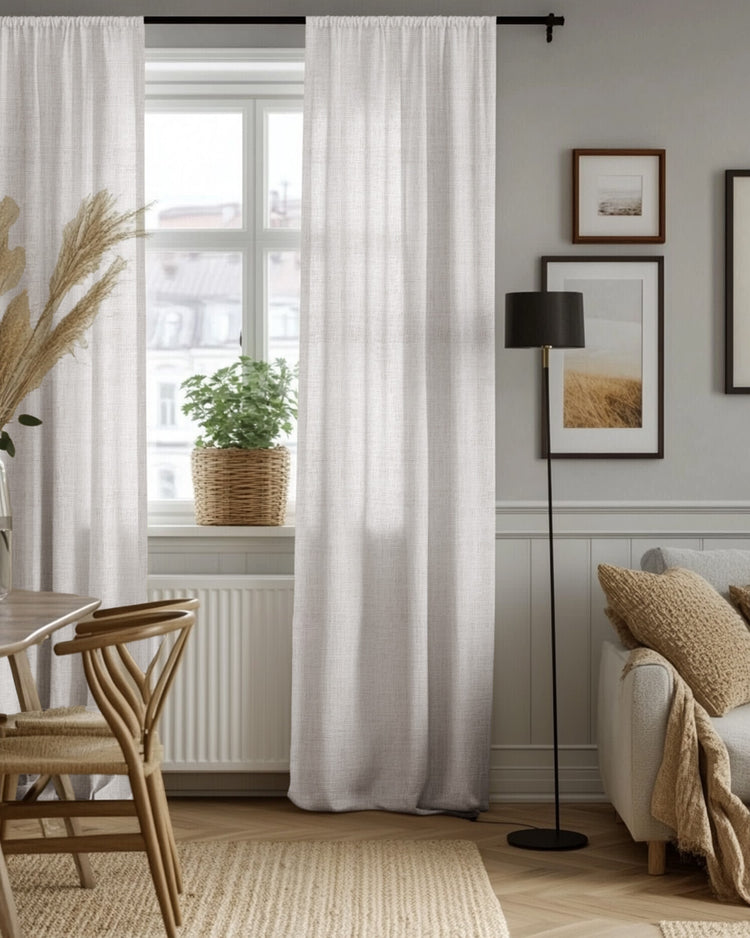
Rod pocket and back tab curtains are gathered directly on the rod. Unlike grommets, which fold naturally, rod pockets rely on "bunching" to look good. If you don't have enough width, these curtains look messy and strained.
This is especially true for sheer curtains. Because sheers are transparent and lightweight, you need much more fabric to create a hazy, luxurious privacy effect.
- Standard Fabric: Aim for 2x fullness.
- Sheer Fabric: Aim for 2.5x to 3x fullness. The more sheers you bunch together, the better the light diffusion and privacy.

4. Double Rods and Layering
When using double rods (e.g., a sheer layer underneath a blackout layer), you need to calculate fullness for both layers independently.
A common design trick is to use high fullness (3x) for the inner sheer layer to create a dense, private background, and a standard fullness (2x) for the outer decorative panels. This balances the "busyness" of the rod. If both layers are too full, the rod can look bulky; if both are too thin, the window looks cheap.

5. Tab Top Curtain Fullness
Tab top curtains hang from loops of fabric. Because they hang relatively flat between the tabs, they generally require less fullness than rod pockets, but you still need overlap to avoid light gaps.
The Calculation Example:
Let's say your curtain rod is 50 inches wide.
- Step 1: Choose your fullness. For Tab Tops, 1.5x is the standard.
- Step 2: Multiply: 50 inches x 1.5 = 75 inches.
- Step 3: Divide by panels. If you want two panels, each panel needs to be roughly 37.5 inches wide.
Note: If you go lower than 1.3x fullness on tab tops, the curtains may not fully close in the middle, compromising your privacy.

Summary: Cheat Sheet
Don't want to do the math? Just follow these standard multipliers based on your curtain type:
| Curtain Type | Ideal Fullness Ratio |
| Grommet / Eyelet | 1.5x to 2x |
| Rod Pocket | 2x to 2.5x |
| Sheers | 2.5x to 3x |
| Tab Top | 1.3x to 1.5x |