Why Bay Window Curtains Are So Difficult to Get Right (and 3 Solutions That Work)


In this article 6 sections
Bay windows are hard to dress because they aren't one window — they're three or more angled sections that meet at corners, so a single straight rod and one pair of panels rarely fit cleanly. The fix is to stop treating the bay as one opening and pick one of three setups instead: frame the whole bay with side panels over your existing blinds, give each section its own curtain panel, or fit a separate Roman shade to each section. Which one is right depends on your wall space, whether there's a bench or radiator below, and how much you want the curtains to operate versus just frame the view.
Below are the three approaches that consistently work, with real homeowner examples and practical guidance for each, plus how to choose between them.

Stationary side panels framing a bay window, with shutters handling light and privacy. Photo: @lydford20 (TheHues Zoe drapes).
Why bay windows are harder than standard windows
A standard window is a flat rectangle, so curtain math is simple. A bay breaks that in three ways.
- Angled corners. Most bays turn at the corners (commonly around 90° for a square/box bay or about 135° for an angled bay). A single rigid rod can't follow those turns, so you either need a rod that bends, a ceiling track shaped to the bay, or separate hardware per section.
- Limited wall space at the corners. Panels need somewhere to stack when open. On a bay, the corners often don't leave room, so panels can block the glass or crowd each other.
- Something is usually below the window. Bay windows frequently sit above a window seat, a built-in bench, a radiator, or cabinetry. Floor-length panels can fight with all of these.
Because every bay's angles, returns, and section widths are different, don't force a straight-window formula onto the project. Each segment and corner changes the finished width and how the treatment operates — which is exactly why measuring (or using design support) matters more here than on a flat window.
Solution 1: Frame the bay with side panels over your existing blinds

Pinch-pleat side panels soften the bay while the existing blinds do the light control. Photo: @the_creative_saint (TheHues Milo pinch-pleat drapes).
The simplest upgrade is to leave your blinds or shutters in place and add a pair of stationary drapery panels on the flat wall to either side of the whole bay. The panels don't draw across the glass — they frame it. The blinds keep doing the daily light and privacy work; the curtains add height, softness, and a finished, hotel-like look.
Best for:
- Living and dining rooms where you want presence without losing the blinds you already have
- Bays with a bench, radiator, or low wall space inside the recess
- A layered, elevated look on a smaller budget (you're adding panels, not replacing everything)
Because the panels are stationary, a pleated header reads beautifully here — double or triple French pinch pleat, Euro pleat, or goblet headers hold a tailored, evenly spaced fold even when they never move. Mount the rod high and wide on the flat wall (above and to the outside of the bay) so the panels frame the recess rather than crowding it. If you're weighing one wide panel versus a pair, our guide on one curtain panel or two walks through it.

 Kid-friendly
 OEKO-TEX® Certified
 Durable
 Low maintenance
Real home example: @lydford20

Photo: @lydford20.
For years, lifestyle creator Sharon Orme (@lydford20) couldn't find curtains that worked with her bay. The blinds were practical, but the room never felt finished. Instead of replacing anything, she layered custom ivory pinch-pleat panels (the Zoe style) around the existing shutters. The panels softened the angles, added vertical height, and gave the room the calm, elevated feel she'd been after, without touching the window coverings that already worked.

Solution 2: Give each section its own curtain panel
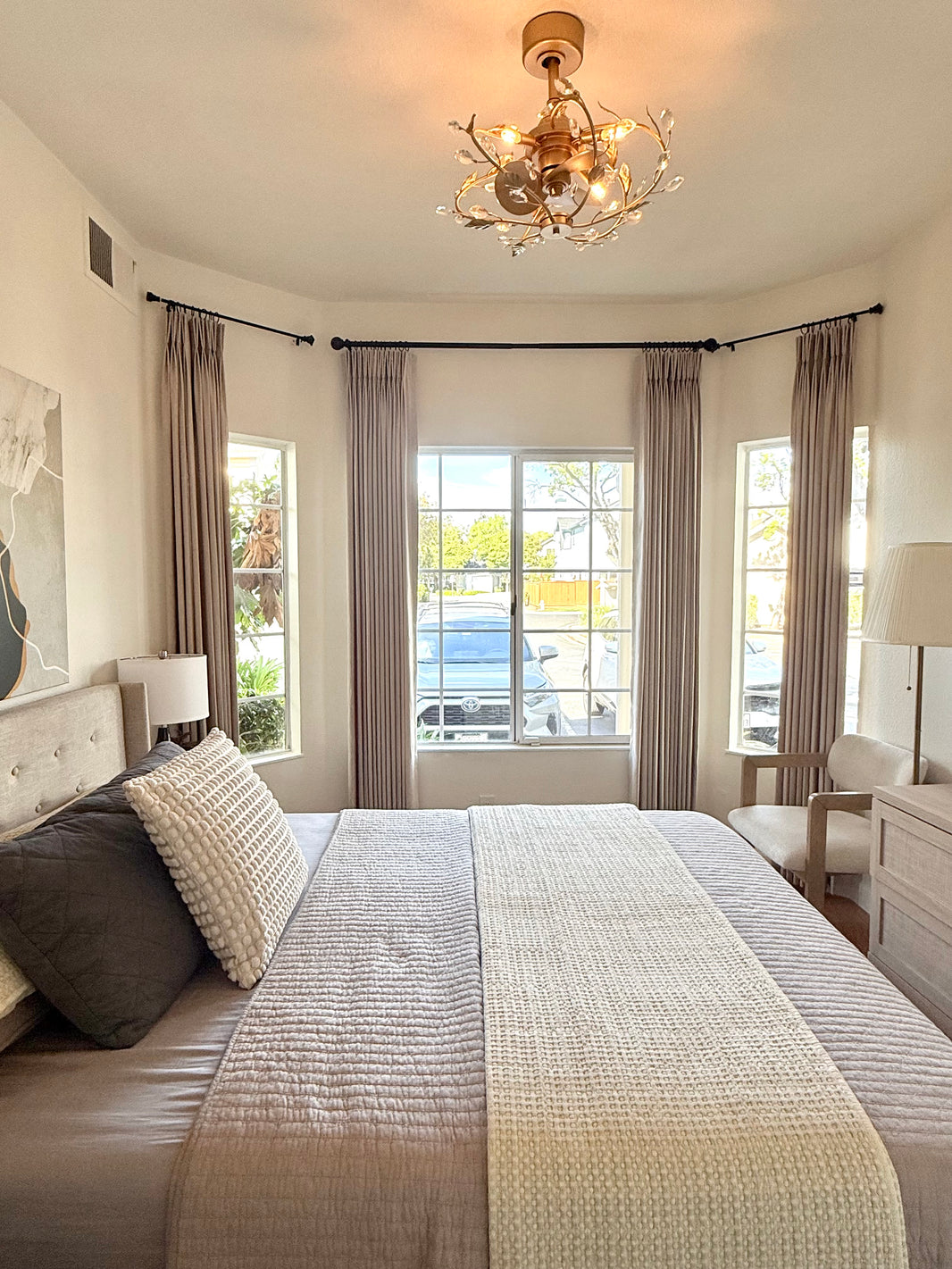
If the architecture allows it, curtains can work right inside the bay. You just treat each section as its own small window rather than the bay as one unit. Each section gets its own panel on its own rod or on a shaped track that follows the bay.
This works best when your bay has:
- Enough flat wall beside each section for the panel to stack when open
- A higher mounting position (so panels clear the sill and any furniture)
- No bench, cabinetry, or radiator directly below to fight with floor-length fabric
The payoff is a soft, tailored look that follows the shape of the bay and adds real warmth and texture. The trade-off is operation and hardware: panels need somewhere to go when open, and you'll need a bendable bay rod, a custom-shaped ceiling track, or separate rods per section. Header choice matters too. If the panels need to open and close often, prioritize hardware that moves smoothly, such as a ceiling track, curtain rings, or grommet panels; rod-pocket and back-tab panels are generally better suited to a more stationary setup. (Our header style guide breaks down the trade-offs.) Because finished width depends on each section's width and the corner returns, this is the setup where a custom fit pays off most.

 Textured wave
 Relaxed Drape
 Breathable comfort
 Timeless design
For a look at this in a real home, this homeowner's reel shows individual panels following the angles of the bay.
Solution 3: Fit a separate Roman shade to each section
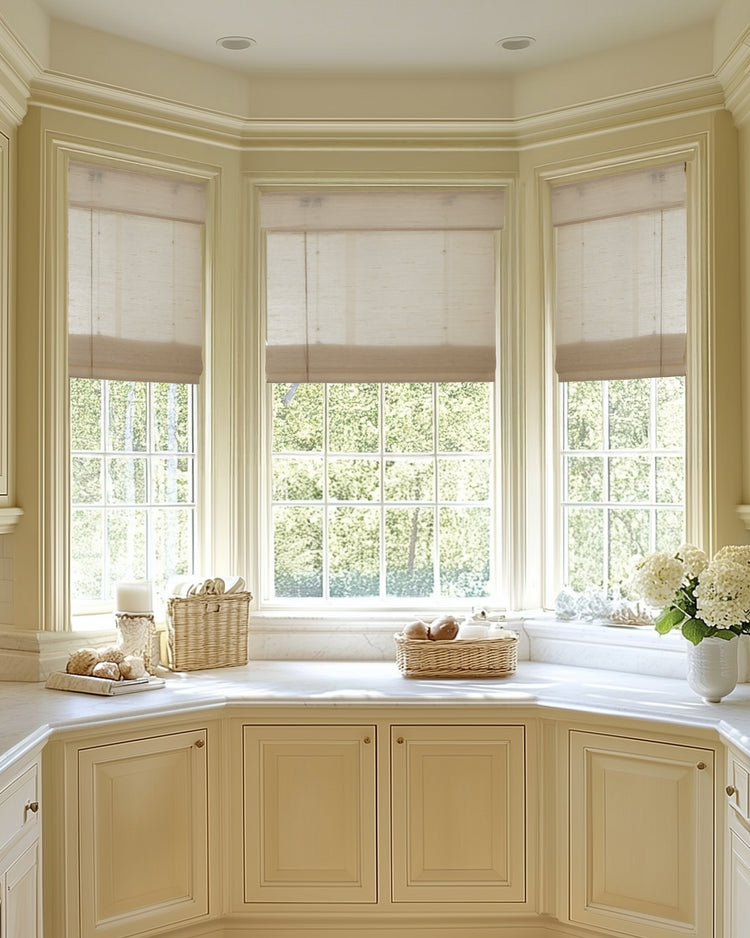
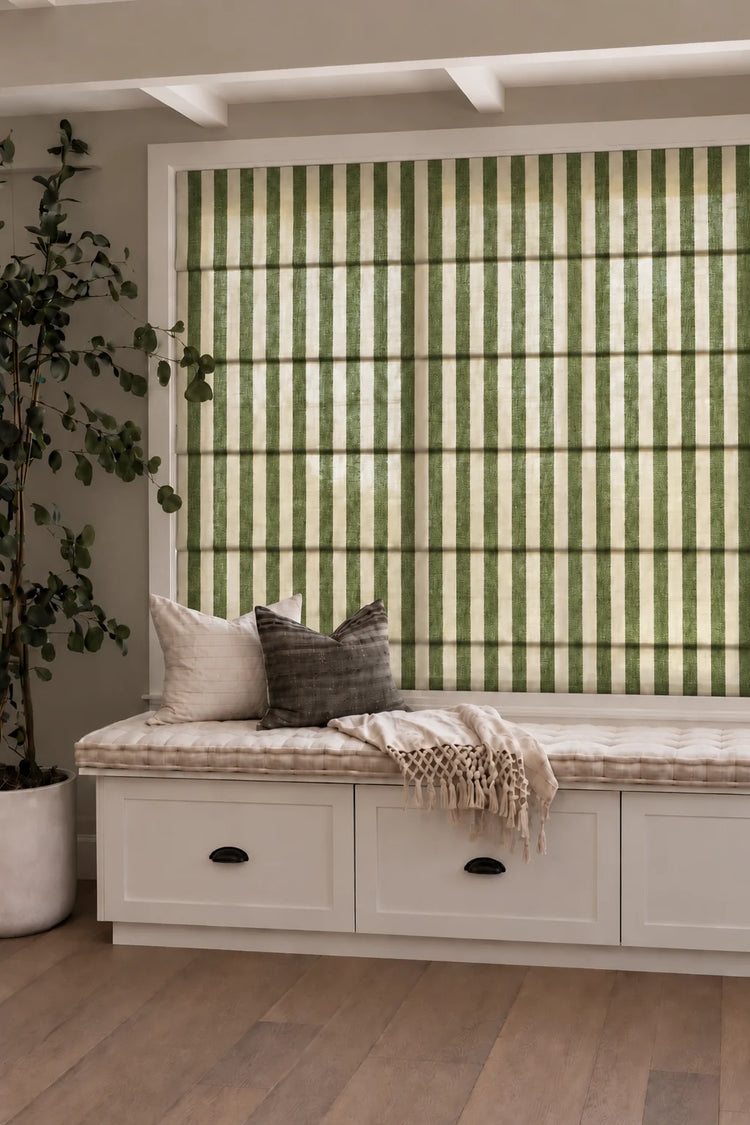
A separate Roman shade on each section keeps the bay's shape and leaves the seating area open. Photo: @kastusha (TheHues Cassie Roman shades).
When the bay has a window seat, a deep sill, storage below, or tight space between sections, full-length curtains get bulky fast. This is where a separate Roman shade on each section is usually the cleanest answer. Each shade is fitted to its own window, so you get privacy and light control with nothing pooling on the floor or blocking the bench. The architecture of the bay stays the focal point instead of disappearing behind fabric.
A few measuring notes specific to per-section Roman shades:
- Inside mount gives the tidiest, built-in look but needs a square frame with at least 3 inches of depth for the headrail to sit cleanly. TheHues' shade tool auto-deducts ½ inch from your inside width for operation, so submit the raw opening — don't subtract twice.
- Outside mount is the move for shallow or uneven frames; extend the shade beyond the opening (TheHues recommends roughly 4–8 inches per side) for more coverage and fewer light gaps.
- Order each section as its own size. Bay sections may not be identical, so measure every section separately rather than assuming one size fits all.

See the shade measurement guide for the full step-by-step, and browse the shades collection for fold styles. In the photo above, @kastusha fitted natural-linen Cassie Roman shades to each section of her bay, so each window keeps its own clean line.
Roman shades also shine as an update for a dated bay. When Julie moved into her home, the bay still had its original 1990s plastic shutters, which felt heavy and out of date. Fitting custom Roman shades to each section, made the room feel lighter and more current while keeping the architecture on display.
How to choose the best bay window treatment
Match the setup to what's below the window and how much you need the curtains to move:
| Your bay window | Best solution | Why |
|---|---|---|
| Has blinds/shutters you like + a bench or radiator below | Solution 1 — frame with side panels | Adds softness and height without disturbing what works |
| Has open wall beside each section, nothing below, higher mount | Solution 2 — a panel per section | Soft, tailored drape that follows the bay's shape |
| Has a window seat, deep sill, storage, or tight sections | Solution 3 — a Roman shade per section | Privacy and light control with zero floor clutter |
Two quick rules that save most mistakes:
- Look down first. What's under the window (bench, radiator, cabinets) usually decides between curtains and shades before anything else.
- Decide whether they need to move. If the treatment is mostly decorative, stationary pleated side panels are easiest. If it has to open and close over the glass, plan the hardware (bendable rod or shaped track) and stacking space up front.
Still not sure which fits your bay?
Every bay is a little different — different angles, section widths, and what sits below the sill. If you're stuck between framing it, paneling each section, or fitting Roman shades, send us a photo of your window. Our free design service will recommend the setup, header style, fabric, and configuration that fit your space — no pressure, just specific advice for your room.