Can you attach a shade sail to a house or fence?


In this article 9 sections
- Quick answer: what can hold a shade sail?
- Can you attach a shade sail to a house?
- Can you attach a shade sail to a fence?
- What a safe shade sail setup needs
- Best shade sail setups for common backyard layouts
- Common shade sail installation mistakes to avoid
- How to choose the right shade sail after your anchors are set
- FAQ
- Final takeaway: can you attach a shade sail to a house or fence?
Yes, you can attach a shade sail to a house in some situations, but only when the anchor points connect to real structure. A shade sail should not be fastened to siding, trim, brick veneer, fence panels, or lightweight fence posts as if those surfaces were load-bearing.
The key rule is simple: attach to structure, not surface. Shade sails work under tension, and that tension increases with wind, rain, and daily movement. A surface can look solid from the patio and still be the wrong place to hold a sail.
This guide explains when a house can work as an anchor, why fences are usually a poor choice, what a safer setup looks like, and how to choose a sun shade sail layout before you order. If you are still planning the shape and size, start with the TheHues sun shade sail measurement guide so you can map anchor points before choosing a sail.
Quick answer: what can hold a shade sail?
Before you choose hardware or fabric, use this basic filter: the anchor point needs to be strong enough for tension and weather movement. Decorative surfaces are not enough.
| Support area | Usually suitable? | What to check first |
|---|---|---|
| Structural wall framing | Often yes | Fasteners must connect to framing, not just siding or sheathing |
| Sound brick, concrete, or masonry | Often yes | The masonry should be structural, solid, and in good condition |
| Reinforced fascia or roofline framing | Sometimes | Needs proper backing and should not rely on surface screws alone |
| Vinyl siding, stucco finish, or cladding | No | These are surface materials, not structural anchor points |
| Brick veneer | No | Veneer is decorative and should not carry sail tension by itself |
| Fence panels | No | Panels flex and are not designed for a tensioned overhead sail |
| Standard fence posts | Usually no | Most are built for fencing loads, not shade sail tension |
| Purpose-built timber or steel posts | Often yes | Post size, footing, height, and soil conditions all matter |
A shade sail does not care whether the anchor is on a house, near a fence, or on a freestanding post. It cares whether the anchor point can stay secure when the sail is pulled tight and exposed to outdoor conditions.

Can you attach a shade sail to a house?
Yes, you can attach a shade sail to a house when the mounting points connect to structural framing, sound masonry, or properly reinforced roofline details. The mistake is assuming the outside finish is the same thing as the structure behind it.
Siding and veneer are not shade sail anchors
Vinyl siding, fiber cement siding, stucco finish, trim boards, and brick veneer can all make a wall look sturdy. But those materials are usually surface layers. They protect or finish the exterior; they are not meant to carry the pull of a tensioned shade sail.
If hardware is fastened only into the surface layer, the setup may seem fine at first, but wind and repeated movement can loosen the connection or damage the exterior. For a house-mounted shade sail, the fastener needs to reach the correct structural backing for that wall type.

Framing, masonry, and reinforcement matter most
If the wall is wood-framed, the anchor needs to tie into framing members, not only sheathing or cladding. If the anchor is near a roofline, fascia, or rafter area, the connection should transfer the load to framing that can handle it.
Brick, concrete, and masonry can work well in the right situation, but only when the material is structural and sound. Damaged mortar, thin veneer, or weak masonry should not be treated as a reliable anchor point.
Before attaching a shade sail to a house, ask:
- What is behind the exterior surface?
- Is the anchor connecting to structure, not just finish material?
- Is the wall, brick, concrete, or framing in good condition?
- Does the anchor line up with the direction of pull from the sail?
- Will the installation still be secure during wind and rain?
If you cannot answer those questions confidently, pause before installing. For larger sails, tall anchor points, unusual walls, or rental properties, it is worth checking with a qualified installer, contractor, or local building professional.
Fascia can work only when it is properly reinforced
Fascia attachment looks clean, which is why many homeowners consider it first. But fascia by itself is not automatically a structural anchor. It may need added blocking, brackets, or reinforcement behind the visible board.
In many patio layouts, the better solution is a hybrid setup: one or two house anchors where structure is available, plus dedicated posts at the open edge. This usually gives the sail better slope, more reliable tension, and less stress on the house.
 Kid-friendly
 OEKO-TEX® Certified
 Durable
 Low maintenance
If you are comparing layouts, the TheHues free design service can help you think through the visual side before ordering, especially when the patio has uneven anchor heights or an awkward shape.
Can you attach a shade sail to a fence?
In most backyard setups, a standard fence should not be used as the main anchor for a shade sail. Fence panels are designed for privacy and boundaries, not for holding a tensioned overhead fabric structure.
Fence panels are usually the wrong place to attach
A fence panel may feel solid when you push on it by hand, but that does not mean it can handle a shade sail. A sail pulls from the corners and can create twisting, leaning, and racking forces, especially when the wind changes direction.
Attaching to panels, rails, or decorative fence pieces can lead to loose hardware, bent boards, leaning sections, or damage that becomes harder to fix later. If the fence is shared with a neighbor or controlled by an HOA, the risk is not only structural. It can also become a maintenance or compliance problem.
Standard fence posts are not always strong enough
Fence posts are stronger than panels, but many are still not designed for shade sail tension. A post can be perfectly fine for a fence and still be a poor sail anchor.
Be especially cautious if:
- the post is older, cracked, or already leaning
- the footing is shallow or unknown
- the post supports a long fence run that moves in wind
- the post is close to a gate
- the sail is large, waterproof, or installed with very little slope
Waterproof shade sails need extra attention because water runoff and pooling risk make slope and anchor strength even more important.
A separate post near the fence is usually safer
If the best shaded area sits close to a fence line, the better move is usually to install a dedicated post just inside the fence rather than using the fence itself. That lets you keep the sail where you want it without asking the fence to serve as structure.
This approach helps because you can control the post size, footing, height, and anchor position. It also makes future fence maintenance easier because the shade sail is not tied directly into the fence assembly.

What a safe shade sail setup needs
Once you stop thinking in terms of house versus fence and start thinking in terms of load-bearing anchor points, the planning becomes much clearer.
Strong anchor points for every corner
Each corner needs a secure anchor that can handle tension. Confirm the anchor points before choosing the final sail size. This helps avoid the common mistake of buying a sail first and then trying to force the structure to fit it.
Enough slope for drainage
Shade sails should not be installed perfectly flat, especially waterproof styles. A sloped layout helps water drain and reduces stress from pooling. Always follow the product's installation guidance for angle, tension, and weather use.
Room for hardware and tension
A shade sail should usually be smaller than the exact anchor-to-anchor opening so there is space for hardware, adjustment, and tensioning. This is why careful measuring matters. If the anchor points are fixed, a custom size may be easier than forcing a stock size into a difficult layout.
Realistic post planning
Posts are part of the structure, not a decorative add-on. The right post size, footing depth, soil condition, and height all affect how well the shade sail performs. For larger or more exposed installations, professional guidance is a smart step.
Best shade sail setups for common backyard layouts
Most successful shade sail installations use a few practical patterns. The right one depends on your anchor points, the shape of the patio, and how much coverage you need.
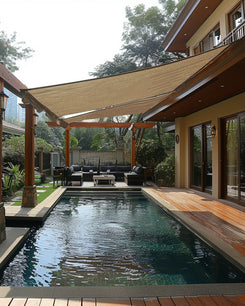
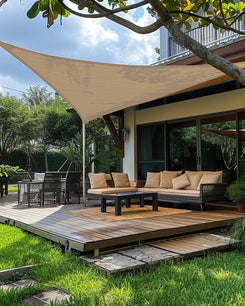
House plus two dedicated posts
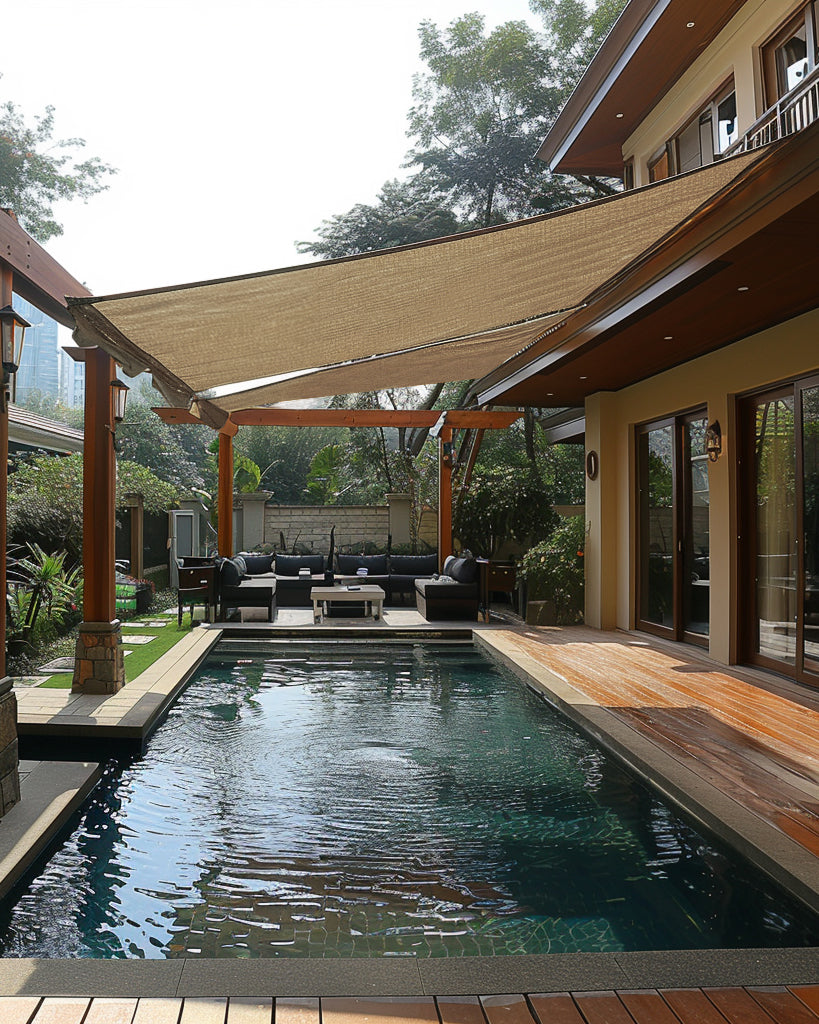
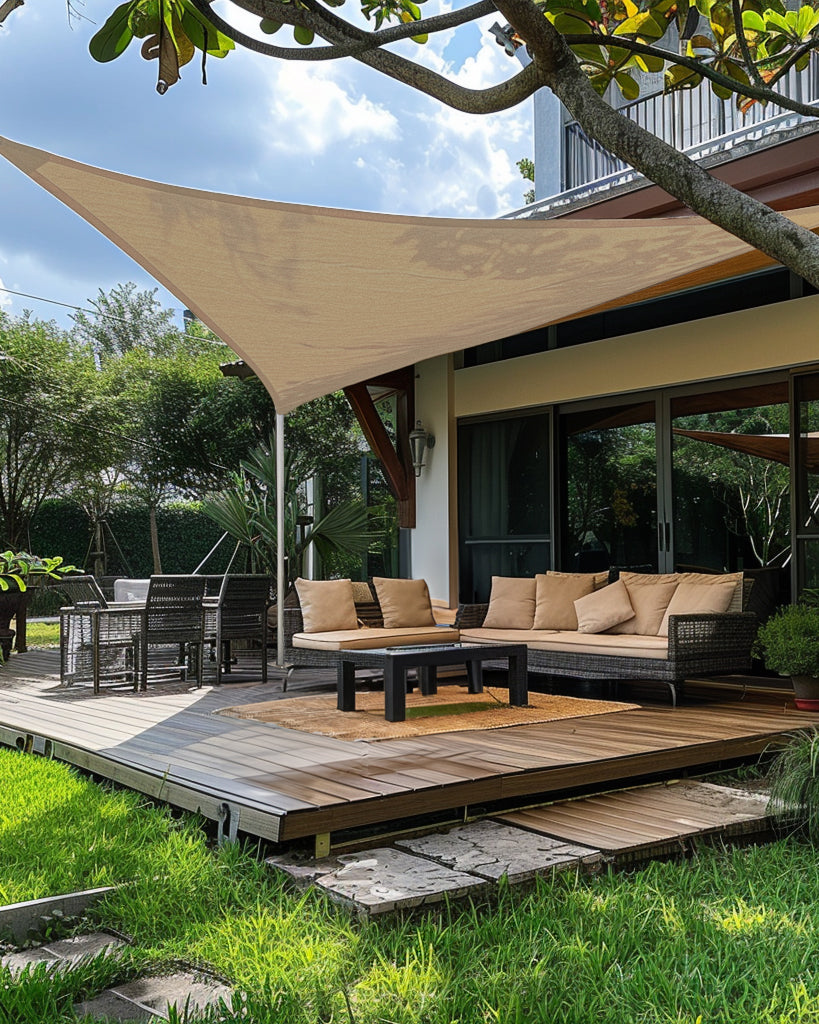
This is often a strong option for a patio next to a house. One side uses structural house anchors where appropriate, and the open edge uses purpose-built posts. It keeps the layout clean without relying on a fence.

Masonry wall plus posts
If one side of the space has sound structural masonry, it may work as part of the anchor plan. Posts on the open side can help you control slope, height, and coverage more easily.
Triangle shade sail for corners or irregular spaces
A triangle sail can work well for side yards, small patios, or awkward corners where a rectangle feels too large. It usually creates a lighter visual footprint and may be easier to position around irregular anchor points.
Freestanding posts near a fence line
If the sail needs to sit near a fence for coverage or privacy, use freestanding posts near that edge instead of the fence itself. You still get shade where you need it, but the fence stays out of the structural plan.
If your main goal is side privacy rather than overhead shade, outdoor curtains may be a better match. They can soften a patio or balcony perimeter without requiring the same tensioned overhead structure.
Common shade sail installation mistakes to avoid
Attaching to surface material only
Siding, trim, stucco finish, brick veneer, and decorative fence elements should not be treated as structural anchors. They may cover the structure, but they are not the structure.
Installing the sail too flat
A flat sail may look neat, but it can trap water and increase stress on the anchor points. Slope is especially important for waterproof shade sails.
Using a fence as if it were a post system
A fence post that works for fencing may still be too light for a shade sail. A fence panel is even less suitable.
Choosing the sail before confirming the anchors
The anchor points should guide the sail size and shape. When the order is reversed, the result is often poor tension, awkward hardware spacing, or a layout that is hard to install safely.
Forcing one oversized sail to do everything
For large patios, two smaller sails may work better than one oversized sail. Smaller sections can be easier to tension, angle, and maintain, depending on the structure and layout.
How to choose the right shade sail after your anchors are set
Once you know where the sail can safely attach, choosing the product becomes much easier.
Triangle vs. rectangle
Choose a triangle shade sail when the space is irregular, the anchor points are uneven, or you want a lighter look. Choose a rectangle shade sail when you need broader coverage over a dining area, lounge area, or rectangular patio.
Waterproof vs. breathable
Choose waterproof when rain protection matters and the installation can be sloped for runoff. Choose breathable when airflow is the priority and you mainly need sun relief rather than rain coverage.
In hot climates, breathable fabric can make a shaded area feel less enclosed. In wetter climates, waterproof fabric may be useful, but only when the slope and anchor strength are planned correctly.
Custom sizing vs. stock sizing
If your anchor points are already fixed, custom sizing is often more practical than forcing a stock sail to fit. Measure the real anchor-to-anchor distances, allow space for hardware, and choose a sail that works with the actual structure.
You can compare available options in the TheHues sun shade sail collection, then use the measurement guide to confirm the layout before ordering.
FAQ
Can you attach a shade sail to siding?
No, not to siding alone. The anchor should pass through the surface and connect to appropriate structural backing. Siding is a finish material, not a load-bearing anchor.
Can you attach a shade sail to a fence post?
Sometimes, but it depends on the post size, footing, condition, and sail load. In most residential situations, a dedicated shade sail post is safer than using an ordinary fence post.
Can you attach a shade sail to fascia?
Sometimes, but only when the fascia area is properly reinforced and the load transfers to suitable framing. It should not be treated as a simple surface-mount shortcut.
Should a shade sail be the same size as the space?
Usually no. A shade sail needs room for hardware, adjustment, and tension, so the finished sail is typically smaller than the anchor-to-anchor opening. Check the product's measurement instructions before ordering.
Can you leave a shade sail up all year?
That depends on the product, installation, and local climate. Strong wind, heavy rain, snow, and storms can increase risk. Follow the product care instructions and remove or loosen the sail when weather conditions require it.
Final takeaway: can you attach a shade sail to a house or fence?
You can attach a shade sail to a house when the anchors connect to suitable structure. You usually should not attach a shade sail to siding, decorative veneer, fence panels, or standard fence posts without confirming they are designed for the load.
The most reliable backyard setups often use a mix of structural house anchors, sound masonry, and purpose-built posts. Start with the anchor points, then choose the sail shape and size around the structure you actually have.
Before ordering, use the TheHues shade sail measurement guide, compare options in the sun shade sail collection, or contact the TheHues help center if you want a second check on a difficult layout.