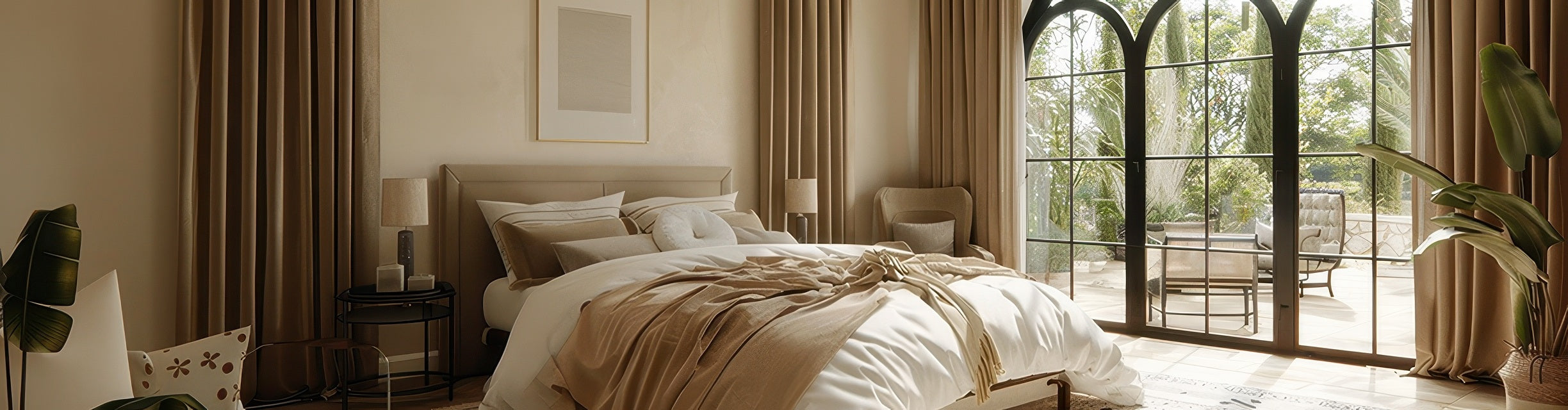
Custom size curtains for renters with awkward windows


Rental homes often come with awkward openings: a living room window that runs almost wall to wall, a bedroom closet without a door, or a bathroom window that needs privacy without blocking all the light. Standard curtains can help, but they often look skimpy, bulky, or temporary when the opening is not a standard size.
That is where custom size curtains can make a real difference. The goal is not to make a rental feel overdesigned. It is to choose a window treatment that fits the opening, works with renter-safe hardware, and makes the room feel more finished without creating move-out problems.
This guide walks through three common rental challenges: oversized apartment windows, open closet openings, and awkward bathroom windows. You will learn what to measure, when to use one panel or two, where cafe curtains make sense, and when a shade may be the better choice.
Why custom size curtains work well for renters
Renters usually have less freedom to change walls, trim, tile, or window frames. That means the curtain size, hardware, and fabric weight need to work together from the beginning.
A ready-made panel may work on a simple bedroom window. Rental openings are often harder. The window may be extra wide, the closet may sit in a tight alcove, or the bathroom may need only lower-half privacy. When the size is almost right but not quite, the whole setup can look like a temporary fix.
Custom sizing helps solve that problem before installation. Instead of accepting panels that are too short, too narrow, or too bulky, you can choose the width, drop, panel count, and lining around the opening you actually have.
This matters even more when you are using tension rods, no-drill brackets, or other renter-friendly hardware. These options can be useful, but they usually have weight limits and span limits. A curtain that is the right size and weight is much easier to live with than one that asks too much from the hardware.
Curtains can also help with comfort. The U.S. Department of Energy notes that windows can contribute to heat loss in winter and heat gain during warmer months. Curtains will not turn an apartment into a sealed system, but the right fabric and lining can help manage glare, privacy, and temperature swings.
If you are working with a tricky opening, start with the TheHues curtain measurement guide before choosing fabric or hardware. Accurate measurements will help you solve the right problem first.

 Plant-based fiber
 Organic hand-feel
 Eco-conscious material
 Timeless elegance
Custom size curtains for oversized apartment windows
Oversized apartment windows usually go wrong in one of two ways. The curtains are too narrow when closed, or they look under-scaled when open. Both problems come from treating a large opening like a standard window.
Start with panel layout before fabric
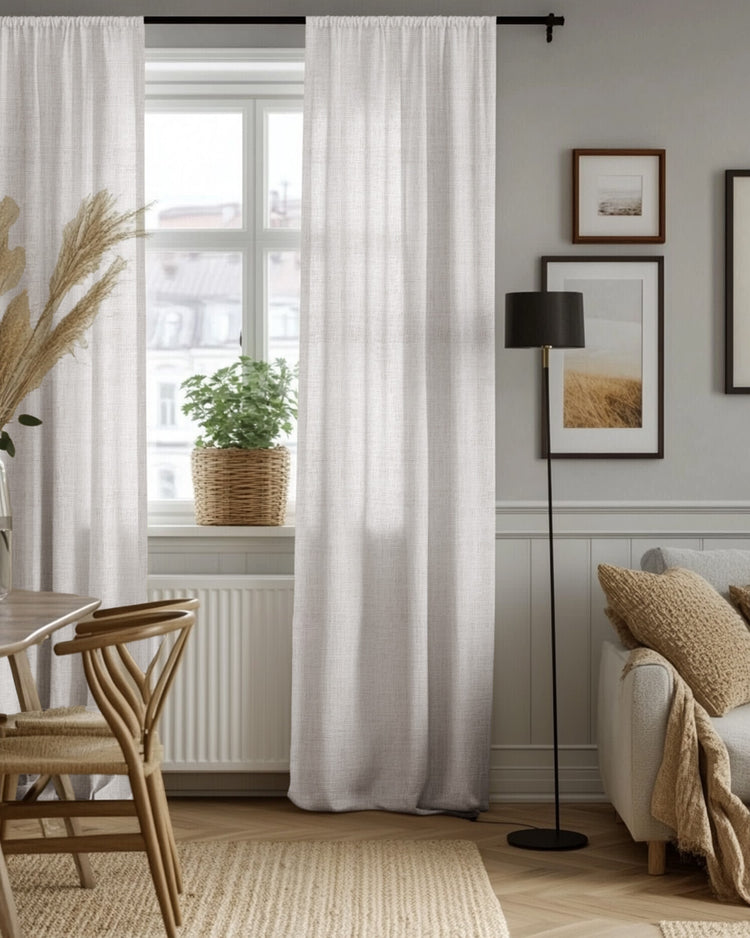
Panel count changes both the look and the daily function of a wide window. For most large windows, two panels are the best starting point because they stack more evenly, look more balanced, and are easier to open and close.
For extra-wide windows or sliding doors, you may need wider custom panels or multiple panels, depending on the rod span and how much fullness you want. The key is to size the panels for the full coverage area, not just the glass.
Use this as a starting point:
- Use two panels for most wide apartment windows where balance matters.
- Use extra wide custom curtains when one side needs more coverage or the wall span is unusually broad.
- Use multiple panels when daily operation matters and a single oversized panel would be hard to move.
If you are unsure whether one panel or two will look better, review TheHues' guide on one curtain panel or two before you place an order.
Match hardware to the window width and your lease
Wide windows put more stress on hardware than small windows. That matters in a rental because renter-safe hardware still needs enough support.
Before choosing a rod or bracket, ask:
- Can the rod be center-supported? If yes, your options usually expand.
- Will the rod mount inside or outside the frame? Outside mount often gives better coverage and makes the window feel larger.
- Will you open the curtains every day? If yes, smooth operation matters more than decorative hardware.
- How heavy will the finished curtains be? Lined or extra-wide curtains need stronger support.
Tension rods can work for smaller inside-mounted windows, but they are rarely the best choice for very wide openings. No-drill brackets may work in some apartments, but you still need to check weight limits and the condition of the trim or wall surface.
For large, sun-heavy windows, lighter fabrics often work better with renter-friendly hardware than very dense heavyweight panels. If you need more performance, review the hardware first instead of assuming any rod can carry the finished curtain.

Choose fabric and lining based on the room's main problem
Large windows can make an apartment feel bright and open, but they can also create glare, heat, and nighttime privacy issues. The fabric should answer the room's real need first.
- For strong afternoon sun, compare blackout or thermal lining options.
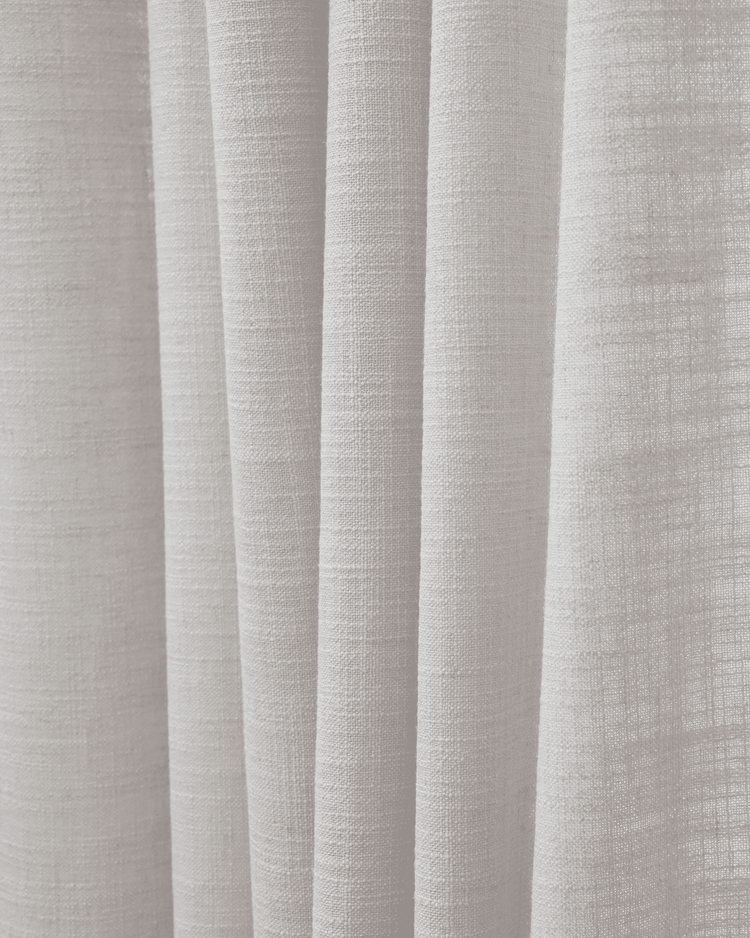
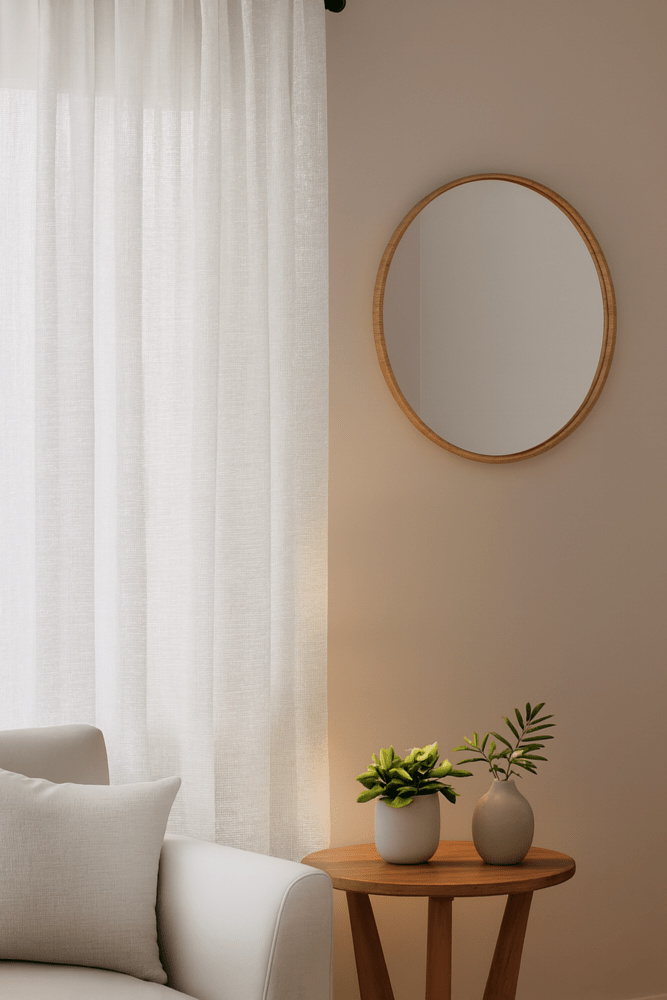
- For a softer living room look, start with a textured light-filtering fabric and add lining if needed.
- For tall glass that feels exposed at night, use fuller custom panels with enough coverage at the sides.
- For rooms that feel cold or drafty, consider whether thermal curtains fit the room better than a purely decorative panel.
If the glass runs high or nearly to the ceiling, extra long curtains or floor-to-ceiling curtains can make the room feel more intentional. The goal is not only coverage. It is proportion.
For a more tailored setup, review the TheHues curtain liner guide before finalizing your configuration.

 Tailored Folds
 Low maintenance
 Motorized Option
 Child-Safe Cordless
Curtains for closet openings in studios and bedrooms
Closet openings create a different rental problem. The issue is usually not light control. It is visual clutter. An exposed closet can make even a tidy room feel unfinished, while the wrong curtain can make daily access annoying.
That is why many renters look for curtains for closet doors even when there is no door at all. They want coverage, but they also want the room to feel calmer and more complete.
Decide whether easy access or a softer look matters more
If the closet is used every day, operation should come before decoration. A curtain that looks nice but drags, snags, or bunches will become frustrating quickly.
For most closet openings:
- A track can give cleaner movement if your lease and wall condition allow it.
- A rod is simpler and often easier for renters.
- A single panel can work for narrow closet openings.
- Two panels usually work better for wider closets because you can open one side at a time.
Use a heading style that can handle daily movement
Closet curtains move more often than most window curtains, so the header style matters. For this kind of opening, smooth operation often matters more than a formal look.
- Grommet headers are usually easy to slide and simple to install.
- Back tab headers can look softer, but they may not move as easily on every rod.
- Pleated styles can look more tailored when the closet is visible from the bed, entry, or living area.
The best choice depends on how often you use the closet and how finished you want the room to feel. Use the TheHues curtain header guide to compare the options before choosing.
Size closet curtains like part of the room
Closet curtains look best when they are treated like part of the room design, not a cover-up. Measure the full opening, decide where the rod or track will sit, and give the panels enough width to close without stretching flat.
Too little fullness can make closet curtains look cheap. Too much bulk can make a small bedroom or studio harder to use. In most rooms, the best result is enough fabric to look soft when closed without taking over the floor area when open.
This is where custom curtains are often more useful than standard panels. You can scale the width to the opening, choose a header that moves smoothly, and pick a length that works with shoes, storage bins, or nearby furniture.

Awkward bathroom windows: privacy without blocking all the light
Bathroom windows are often small, oddly placed, or close to moisture. The right answer is not always a full curtain. You need privacy, but you also need daylight and a fabric choice that makes sense for the location.
Most bathroom window privacy ideas fall into two groups: soft fabric treatments or low-profile shades. The better choice depends on where the window sits, how much moisture reaches it, and how much light you want to keep.
When cafe curtains make sense
Cafe curtains work well when the privacy issue is at eye level but you still want natural light from the top half of the window. They are especially useful for windows beside a vanity, near a tub, or on the lower half of a street-facing bathroom window.
Short custom panels help because bathroom windows are rarely the exact size of ready-made cafe curtains. A custom width keeps the curtain from looking too thin, and a custom drop helps keep the fabric away from splash-prone areas.
Choose fabric with moisture and maintenance in mind
Bathrooms need a more practical fabric filter than bedrooms or living rooms. If the window sits near a shower or tub, avoid curtains that feel heavy, precious, or difficult to clean.
- Choose lighter fabrics for damp bathrooms.
- Keep the hem away from splash zones.
- Avoid puddling or extra fullness in tight bathrooms.
- Use denser light-filtering fabric if a sheer curtain does not provide enough privacy.
Know when a shade is better than a curtain
Not every bathroom window should use curtains. If the window is very small, directly exposed to water, or surrounded by tile with little mounting space, a shade may be cleaner and easier to maintain.
| Bathroom window situation | Curtains usually work best when | A shade may work better when |
|---|---|---|
| Lower-half privacy issue | You want softness and daylight from above | The window is directly exposed to water |
| Narrow or shallow window | There is enough trim or wall space for a small rod | There is very little mounting room |
| Powder room | The curtain can add style and privacy | You want the smallest visual footprint |
| Family bathroom | The fabric can stay clear of moisture | You need a wipe-clean, low-maintenance option |
If you are unsure which format fits your bathroom best, use the TheHues visualization tool to compare the look before ordering.

How to measure custom size curtains for awkward rental openings
Measure after you know how the treatment will mount. A curtain sized for an inside mount will not behave the same as one sized for an outside rod, and this difference matters on rental windows, closets, and bathrooms.
For oversized apartment windows
Measure the full rod width if the curtains will mount outside the frame. Then decide how much space the panels need to stack at the sides when open.
Next, measure the drop from the rod to the finish point:
- Just above the floor for an easy-care look
- Lightly touching the floor for a tailored finish
- Sill length only when the room or furniture layout calls for it
For closet openings
Measure the full opening width, then decide whether the rod or track should sit exactly above the closet or extend slightly past it. A little extra width can help the opening feel less cramped and make access easier.
Then choose whether the curtain should stop just above the floor, skim the floor, or end higher for shoes, bins, or furniture clearance.
For bathroom windows
Measure the part of the glass that actually needs privacy. This will tell you whether a cafe curtain is enough or whether you need fuller coverage.
Also check:
- how close the fabric will sit to water
- whether the rod must mount inside the frame or on the trim
- whether the curtain needs to clear tile, hardware, a sill, or a vanity
Renter-safe curtain installation checklist
The installation method should match the opening, the curtain weight, and your lease. A setup that works for a dry bedroom closet may not be right for bathroom tile or a very wide living room window.
- Check your lease first. Some rentals allow small holes, while others are strict about trim, tile, or anchors.
- Match hardware to span and weight. Wide windows and lined curtains need more support than light cafe curtains.
- Think about daily use. Closet curtains should move more smoothly than decorative side panels.
- Plan around the whole room. Furniture, radiators, vanities, and storage all affect where panels should start and stop.
- Choose fabric after the hardware is realistic. Renter-safe hardware may limit how heavy the curtain can be.
Much of the advice on how to hang curtains in an apartment focuses only on avoiding holes. That is important, but it is only half the job. The curtain still needs to fit the opening and work every day.
FAQ about custom size curtains for renters
Are custom curtains worth it in a rental?
They can be worth it when the opening is unusual, the room needs better privacy or light control, or standard panels make the space look unfinished. Custom curtains are usually most helpful for wide windows, closet openings, sliding doors, and bathrooms where standard sizes do not fit well.
Can I hang curtains in an apartment without drilling?
Sometimes. Tension rods, no-drill brackets, adhesive supports, and certain clamp-style systems may work depending on the opening and curtain weight. Always check your lease and the hardware's weight limit before installing.
What curtains are best for an open closet?
Choose curtains that are easy to move and sized for the full opening. Two panels often work better than one on wider closets because you can access one side at a time. A smooth header style also helps if you open the closet daily.
Are cafe curtains good for bathroom windows?
Yes, cafe curtains can work well when you need lower-half privacy while keeping daylight from the top of the window. They are best when the fabric can stay away from direct water and the hem will not sit in a splash zone.
Should renters choose curtains or shades?
Choose curtains when you want softness, coverage, and a more finished look. Choose shades when the window is very small, close to water, or needs the smallest possible footprint. In some rooms, a shade plus side panels gives the best balance.
Final takeaway
Oversized windows, open closet openings, and awkward bathroom windows all create different rental problems, but the same rule usually solves them: fit first, hardware second, fabric third.
When the size is right, the room feels calmer and more intentional. When the size is wrong, even nice fabric can still look like a workaround.
Keep these points in mind before ordering:
- Wide apartment windows need a real panel strategy, not just a longer rod.
- Closet curtains should be sized for daily access, not just coverage.
- Bathroom curtains need privacy and moisture logic at the same time.
- Renter-safe hardware works best when the curtain weight and dimensions are chosen around it.
To move from guessing to ordering with more confidence, start with the curtain measurement guide, compare custom size curtains, and use the free design service if your rental opening is hard to judge from measurements alone.