Blackout and Room Divider Curtains for Hospitality Projects: What to Specify, What to Confirm


Before you read — quick spec check: - Need blackout + room divider on the same project? Jump to where they overlap - Need NFPA 701 documentation? What to confirm with your supplier - Ready to discuss specs? Talk to the trade team
Hospitality projects rarely need just one type of curtain. Guest rooms require blackout performance. Conference areas, ballrooms, and flexible suites require room division. And in a growing number of projects, extended-stay properties, adaptive reuse hotels, multi-use event spaces, both blackout and room divider curtains need to be specified together, evaluated against the same fire-retardant standards, and coordinated on a single project timeline.
This guide covers what designers, FF&E teams, purchasing managers, and project leads should evaluate when specifying blackout and room divider curtains for hospitality projects. It explains where these two requirements overlap, what compliance standards apply, and what to confirm with a supplier before locking in a specification.
Why blackout and room divider needs overlap in hospitality
Most curtain suppliers treat blackout curtains and room divider curtains as separate product categories. In practice, hospitality projects often require both, and the specification decisions are more connected than they appear.
Guest rooms
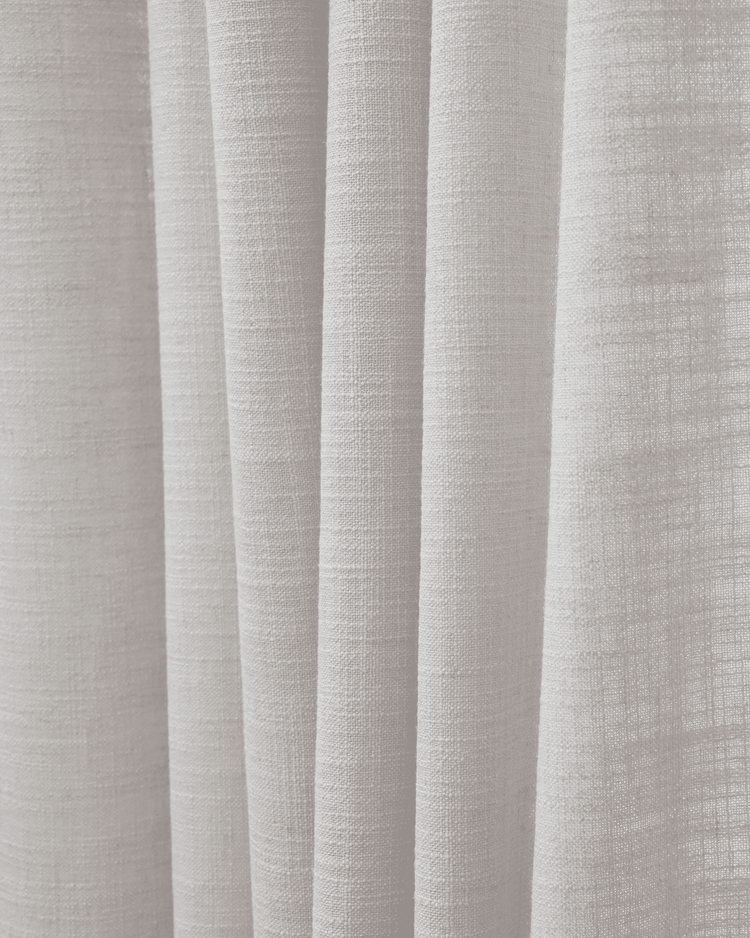
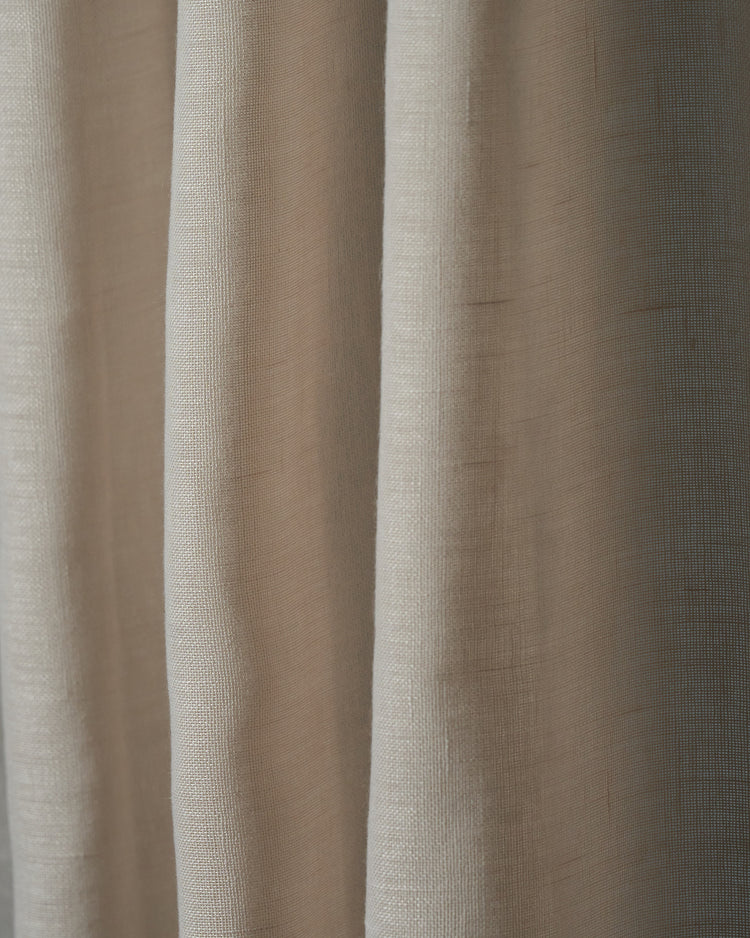
Blackout curtains are a baseline guest room requirement. Hotels, resorts, and serviced apartments need full light blocking to support sleep quality, manage solar heat gain, and meet guest expectations. The specification usually includes blackout lining, custom sizing to fit non-standard windows, and a header construction durable enough for daily use across hundreds of rooms.
Shared and flexible spaces
Room divider curtains serve a different function: creating separation in open-plan spaces. Ballrooms that need to split into breakout areas. Conference rooms that flex between configurations. Restaurant zones that need visual and acoustic privacy between sections. Spa treatment areas. Lobby lounges.
In these applications, the curtain is not just decorative. It defines the room layout and affects how the space is used, booked, and experienced.
Where both requirements meet
The overlap is increasingly common. Suite-style hotel rooms may need blackout curtains at the window and a room divider between the sleeping and living areas. Extended-stay properties use curtain dividers to create flexible bedroom configurations, and those dividers often need blackout performance. Multi-use event venues need room dividers that block light for AV presentations while also separating concurrent sessions.
When both needs are present, evaluating them together, rather than as unrelated product decisions, reduces specification conflicts and keeps the project on a single procurement track.

What to specify for hospitality blackout curtains
Specifying commercial blackout curtains for a hospitality project is not the same as selecting a blackout option from a consumer catalog. The requirements are more exacting, the quantities are larger, and the curtains need to perform consistently across every room in the property.
Light-blocking performance
True blackout means minimizing visible light intrusion when the curtain is closed. In hospitality, that usually depends on the full construction, often a blackout lining or layered build, plus track details that reduce side and top light gaps. The liner guide explains how different lining types affect light blocking, thermal insulation, and fabric drape, all of which matter in a commercial application.
Some projects specify 95-99% light blocking rather than full blackout. This is common in lobby areas or dining spaces where privacy matters more than total darkness. Clarify the required performance level early so the supplier can recommend the right construction.

Fabric and construction durability
Hotel curtains get opened and closed far more often than residential curtains. The header construction, pinch pleat, ripplefold, grommet, or rod pocket, needs to handle daily use without sagging, pulling, or wearing at stress points.
For hospitality projects, prioritize:
- Header types rated for high-frequency operation
- Fabrics that maintain drape and appearance after repeated handling
- Seam construction that holds up across hundreds of open-close cycles
Custom sizing
Standard curtain sizes rarely match hospitality window openings. Floor-to-ceiling glass, non-standard window widths, and recessed curtain pockets all require custom measurements. Confirm that the supplier can produce to exact specifications rather than offering only fixed-width panels.
Thermal and acoustic contribution
Blackout curtains with proper lining also reduce heat transfer through glazing. In hotels with large window walls, this affects HVAC load and energy cost. Some blackout constructions, particularly multi-layer builds, also provide measurable sound reduction, which matters in urban hotels or properties near transport corridors.
What to specify for hotel room divider curtains
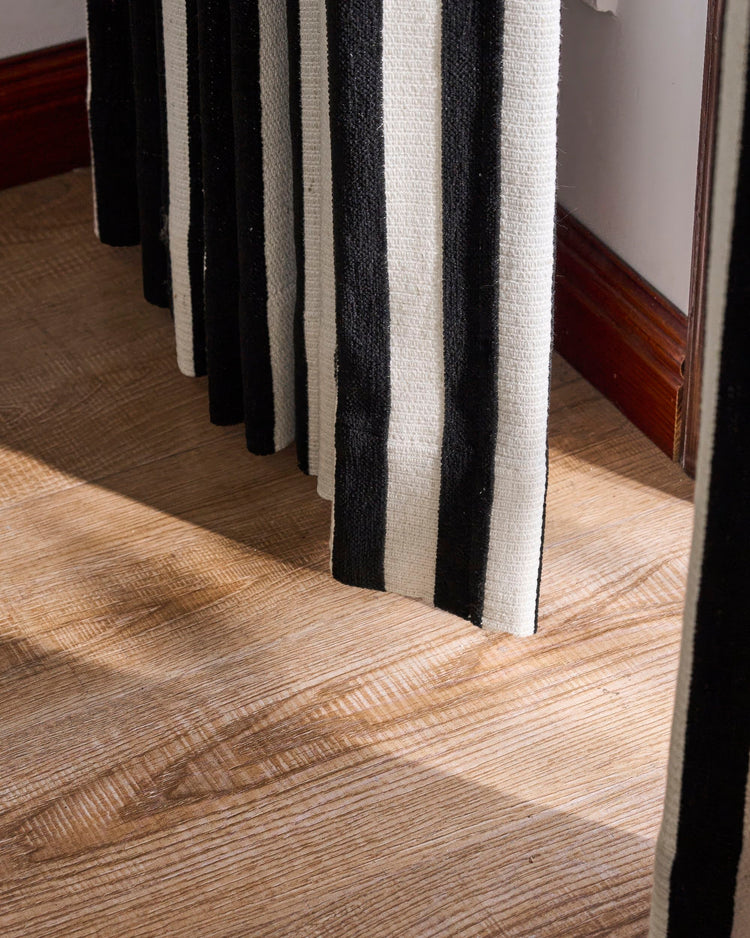
Room divider curtains for hotels and commercial spaces need a different specification approach than window curtains. The curtain is structural in the sense that it defines the usable layout of a room, so the track system, opacity, and fabric weight all need to match the application.
Application types
Common hospitality room divider applications include:
- Ballroom and event space partitioning, dividing a single large room into bookable sections
- Conference and meeting room flexibility, allowing one room to split into 2-3 configurations
- Restaurant and dining zone separation, creating visual and acoustic boundaries between service areas
- Suite and extended-stay room division, separating sleeping areas from living or work spaces
- Spa and wellness partitioning, creating treatment zones in open-plan environments
Each application has different requirements for opacity, sound control, track configuration, and curtain weight. A ballroom divider that needs to block stage lighting is a different specification than a restaurant divider that only needs visual separation.

Ceiling track systems
Room divider curtains require ceiling-mounted track systems. Unlike window curtains, where the track or rod is a secondary decision, the track is fundamental to how a room divider performs.
Key track considerations for hospitality projects:
- Load capacity, heavier blackout or acoustic fabrics require tracks rated for higher weight per linear foot
- Bend and curve capability, some spaces need curved or L-shaped track configurations
- Motorization, large-format dividers in ballrooms or conference centers may need motorized track operation
- Mounting condition and support, track attachment differs between drywall ceilings, suspended ceiling systems, exposed structure, and recessed pockets, so confirm where structural support actually comes from
Specify the track system at the same time as the curtain fabric, not afterward. Mismatched track and curtain weight is one of the most common specification errors in commercial room divider projects.
Opacity and light control
Not every room divider needs full blackout. Define the required opacity level based on how the divided spaces will be used:
- Full blackout, required when the divider must eliminate light transfer between zones (AV presentations, sleeping areas, photography studios)
- High opacity (90-99%), suitable when strong visual privacy is needed but total darkness is not critical
- Semi-opaque, appropriate for visual separation where ambient light should still pass between zones (restaurant sections, lobby areas)
Acoustic performance
In many hospitality applications, a room divider needs to reduce sound transfer between zones, not just block sightlines. A ballroom split into two event spaces, or a restaurant with a private dining section, needs some degree of acoustic separation.
Heavier, multi-layer curtain constructions provide better sound absorption than single-layer fabrics. If acoustic performance is part of the requirement, specify it explicitly and ask the supplier for acoustic data or test results rather than relying on general marketing claims.
Fire-retardant compliance for hospitality curtains
Fire-retardant compliance applies to both blackout and room divider curtains in commercial hospitality settings. This is one of the strongest reasons to evaluate both product types together. They face the same standard, and confirming compliance once across the full curtain specification is more efficient than verifying it separately for each product.
Why NFPA 701 matters
NFPA 701 is the standard fire test for flame propagation of textiles and films. It is the most commonly referenced fire code for hospitality drapery, curtains, and fabric dividers used in commercial and public-occupancy buildings in the United States.
Most jurisdictions require that curtains and fabric room dividers used in hotels, event spaces, restaurants, and other public-occupancy environments pass NFPA 701 testing. This is not optional for most hospitality projects. It is a condition of occupancy permits and fire marshal approval.
What the standard tests
NFPA 701 measures how a fabric responds to a controlled ignition source. It does not test whether a fabric is fireproof. It tests whether the fabric self-extinguishes and limits flame propagation within defined parameters.
There are two test methods:
- Test Method 1, for single-layer fabrics and curtains under 700 g/m²
- Test Method 2, for heavier, multi-layer curtain assemblies and composite constructions
Room divider curtains with blackout lining or acoustic layering may need to be tested under Method 2 because of their multi-layer construction. Confirm which test method applies before finalizing the specification.
Room dividers and fire code scrutiny
Room divider curtains often face closer fire code review than window curtains. The reason is functional: a room divider defines the layout of a space and can affect egress paths, exit visibility, and fire compartmentalization. A fire marshal reviewing a ballroom divider installation may ask for documentation that would not be required for a guest room window curtain.
If the project includes room dividers in any public-occupancy space, confirm NFPA 701 compliance early and request test documentation from the supplier, not just a general compliance claim.

How to confirm compliance with a supplier
When evaluating a supplier for fire-retardant hospitality curtains, request:
- The specific NFPA 701 test method the product has passed
- Test documentation or a certificate of compliance
- Confirmation that the tested construction matches the specification being quoted (fabric, lining, and assembly)
- Clarification on whether the compliance applies to the fabric alone or to the full curtain assembly as specified
TheHues can discuss fire-retardant curtain options for custom projects and confirm which fabrics or constructions have supporting compliance documentation.
How to evaluate a supplier for hospitality curtain projects
Selecting a curtain supplier for a hospitality project involves more than comparing fabric swatches. The supplier needs to support custom specification, fire-retardant documentation, project-scale production, and timelines that align with construction or renovation schedules.
Key evaluation criteria
- Customization range, can the supplier produce to exact window and room divider dimensions, with the header type and lining configuration the project requires?
- Fire-retardant certification, does the supplier provide NFPA 701 documentation for the specific product construction being quoted?
- Production lead time, what is the realistic timeline from order confirmation to delivery? For reference, custom curtain lead times in this category typically range from 9-23 working days, depending on complexity and volume.
- Sample availability, can the supplier provide fabric and construction samples before the full order is placed?
- Trade or account-based ordering, does the supplier offer a trade program that supports project-scale pricing, dedicated support, and specification review?
Why trade programs matter for hospitality projects
A supplier with a structured trade program can reduce friction across the specification and procurement process. Trade accounts typically provide access to project pricing, dedicated support for specification questions, sample ordering, and streamlined reordering for multi-property rollouts.
For hospitality projects that involve both blackout and room divider curtains, a trade relationship also makes it easier to coordinate both product types under one supplier, reducing the number of vendors, purchase orders, and compliance verification steps the project team needs to manage.
Frequently asked questions
Do hotel blackout curtains need to be fire retardant?
In most US jurisdictions, yes. Hotels are classified as public-occupancy buildings, and curtains used in guest rooms and public areas typically need to pass NFPA 701 fire testing. Confirm the specific requirement with the local authority having jurisdiction (AHJ) before finalizing a specification.
Can room divider curtains provide full blackout?
They can in some applications, but the achievable result depends on the curtain build, overlap, track layout, and how well the installation controls light gaps. For hospitality projects, confirm the target light-control level with the supplier before treating a room divider as a true blackout solution.
What is NFPA 701 and does it apply to hotel curtains?
NFPA 701 is the US standard fire test for textiles used in public-occupancy buildings. It measures flame propagation and self-extinguishing behavior. It applies to curtains, drapery, and fabric room dividers used in hotels, event venues, restaurants, and other commercial spaces.
How do I specify blackout and room divider curtains for hospitality projects?
Start by mapping the curtain requirements by space type, guest rooms, ballrooms, conference areas, suites, dining zones. Identify which spaces need blackout, which need room division, and which need both. Then evaluate fabric, lining, track, and fire-retardant compliance across the full specification before selecting a supplier. Consolidating both product types under one vendor simplifies procurement and compliance verification.
What lead time should I expect for custom hospitality curtains?
Lead times vary by supplier, order complexity, quantity, and approval workflow. For large-scale hospitality projects, confirm the production timeline early and factor in sample review, compliance checks, freight, and installation scheduling rather than relying on a generic standard window.
Discuss your project
If you need blackout and room divider curtains for hospitality projects, the most efficient next step is a project discussion. Talk to the TheHues team to review your specification requirements, confirm fire-retardant compliance, request samples, and align on timeline and pricing.