Maximizing the Potential of Your Soundproof Curtains


In this article 9 sections
- Start with the window before choosing noise-reducing curtains
- Choose heavier curtain materials for better noise reduction
- Use fullness to help curtains absorb more sound
- Reduce gaps with the right curtain hardware
- What noise-reducing curtains can and cannot do
- Best rooms for noise-reducing curtains
- Common mistakes to avoid
- Frequently asked questions
- Final takeaway
Noise can still get through a window even after you hang heavier curtains. That does not always mean the curtains failed. In many homes, the bigger issue is that sound is slipping through small gaps around the window, above the rod, along the sides, or under the bottom edge.
Noise-reducing curtains work best as part of a full window setup. The fabric adds softness and mass, while the installation controls the gaps where sound and air can pass through. If you want a quieter bedroom, office, nursery, or apartment, start by checking the window before replacing the curtains.
This guide explains how to choose denser curtains, size them with enough fullness, and install them in a way that helps reduce everyday outside noise without overpromising complete soundproofing.
Start with the window before choosing noise-reducing curtains
Before focusing on curtain fabric, check the window itself. Air and sound often move through the same small openings. If you feel drafts around the frame, you may also be hearing more traffic, voices, wind, or neighborhood noise through those gaps.
Use a simple draft check instead of guessing:
- Close the window completely.
- Turn off fans and HVAC airflow near the window.
- Move your hand or a thin tissue slowly around the window edges.
- Watch for movement or feel for cold air around the frame, sash, and sill.
If you find drafts, address those first. Weather stripping, window-safe caulk, or other appropriate sealing methods can often improve the base condition of the window before the curtain does its part.
This step is especially important if you are shopping for custom curtains. A well-sized curtain can help cover the opening, but it cannot fully compensate for a poorly sealed window.

Choose heavier curtain materials for better noise reduction
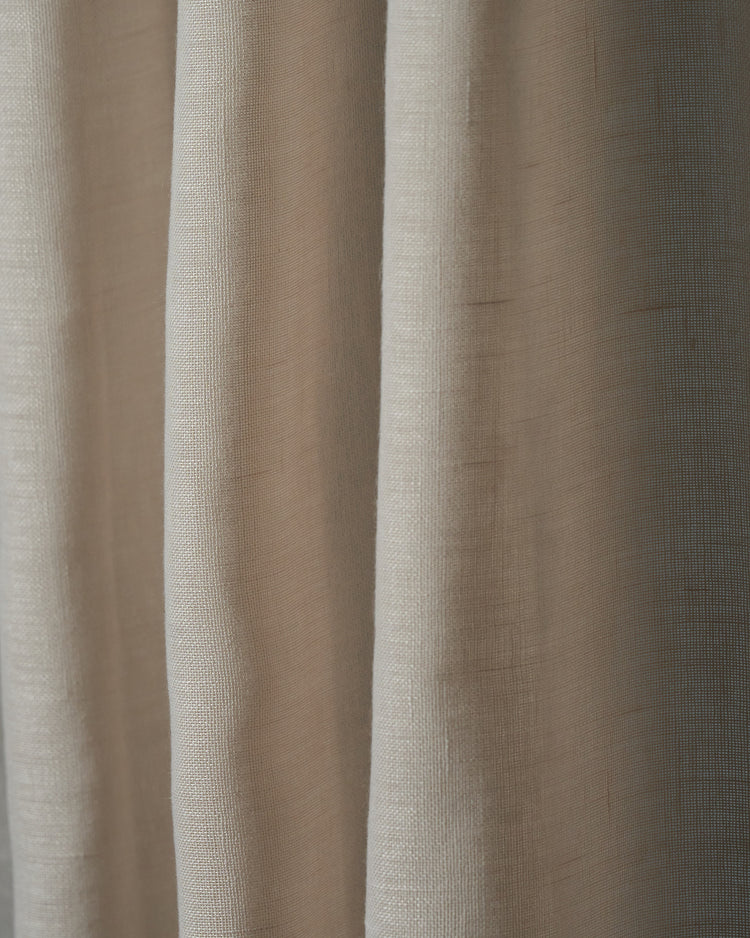
For sound control, fabric weight matters. Lightweight panels may soften the look of a room, but they usually do very little for traffic noise, voices, or echo. A denser curtain gives sound waves more material to pass through, which can help reduce everyday noise and make the room feel calmer.
Look for curtains with a heavier face fabric, a substantial weave, and an appropriate liner. Blackout and thermal constructions can be useful because they often add more layers and density than basic decorative panels.
When comparing options, ask these questions:
- Is the fabric dense enough to feel substantial in the hand?
- Does the curtain include a liner or multi-layer construction?
- Will the fabric drape well with the amount of fullness you need?
- Is the curtain practical for how often you will open and close it?
If the room also needs darkness for sleep, start with blackout curtains. If the goal is comfort near drafty or cold windows, compare thermal curtains as well. For many rooms, the best choice is not one feature alone, but the right balance of fabric weight, lining, coverage, and daily usability.

 100% Blackout
 Better sleep
 Noise Reducing
 Energy Saving
Use fullness to help curtains absorb more sound
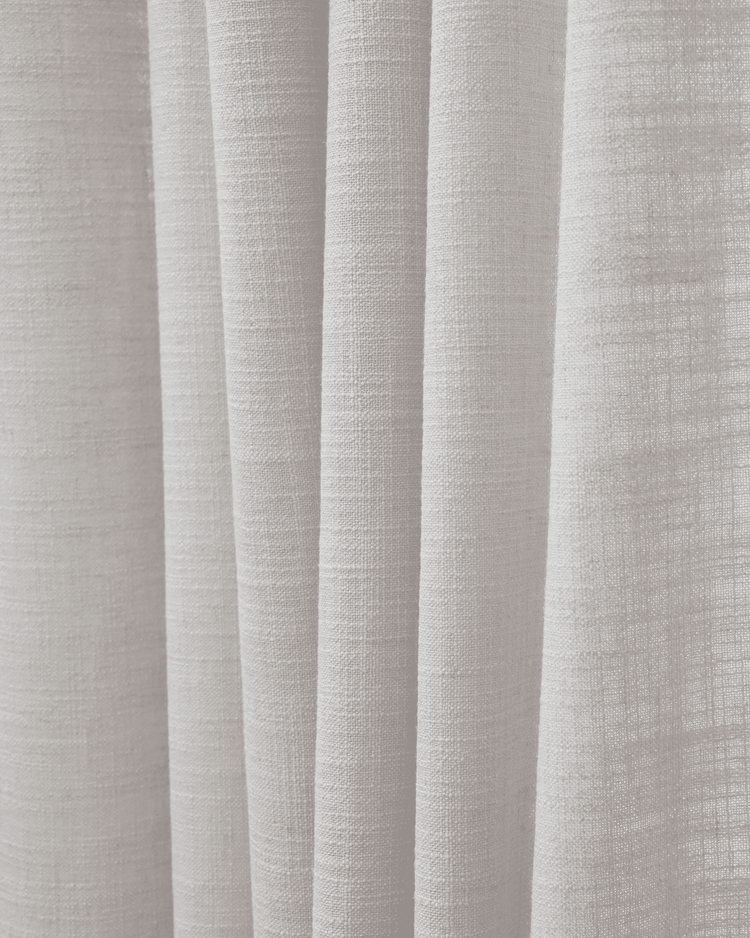
Flat curtains are rarely the best option for noise reduction. When fabric is pulled tight across the window, there is less texture and depth to help soften sound. Fullness creates folds, and those folds add more surface area and more fabric depth across the opening.
That does not mean every room needs extremely heavy, oversized drapes. The goal is to create enough fullness for the panels to hang in relaxed folds when closed.
For most custom curtain setups, review:
- the total window width
- the finished curtain width
- the header style
- the stack-back space on each side
- whether the curtain still has folds when fully closed
Too little fabric can make the curtains look flat and underpowered. Too much fabric can make a small room feel crowded. If you are not sure where to start, use the TheHues curtain measurement guide before choosing your finished size.

Header style also matters. Pleated curtains often look more tailored and keep the folds more consistent, while grommet or rod pocket styles may feel more casual. Before ordering, compare options in the curtain header guide so the top style supports both the look and the function of the room.

Reduce gaps with the right curtain hardware
Even dense curtains can underperform if the installation leaves open channels around the edges. Light, drafts, and noise tend to find the same weak points: the top, sides, and bottom.
For better coverage, focus on how the curtain meets the wall and floor.
Use wider coverage at the sides
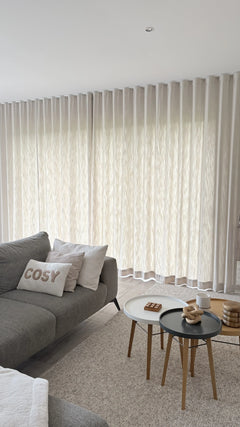
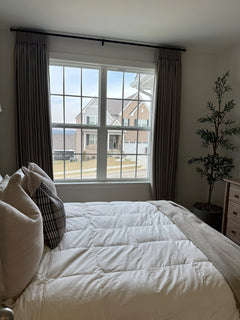
Mount the rod wider than the window frame when your space allows. This gives the panels room to cover more wall area and helps reduce side gaps when the curtains are closed. It also lets the panels stack off the glass during the day, which keeps more daylight available.
Consider a wraparound rod
A wraparound rod, sometimes called a French return rod, lets the curtain curve back toward the wall. This helps close the side gap that standard rods often leave behind.

Mount higher when possible
A higher rod can help reduce the top gap and make the window look taller. For bedrooms and home offices, this can improve both the look of the room and the coverage around the window.
Think about the bottom edge
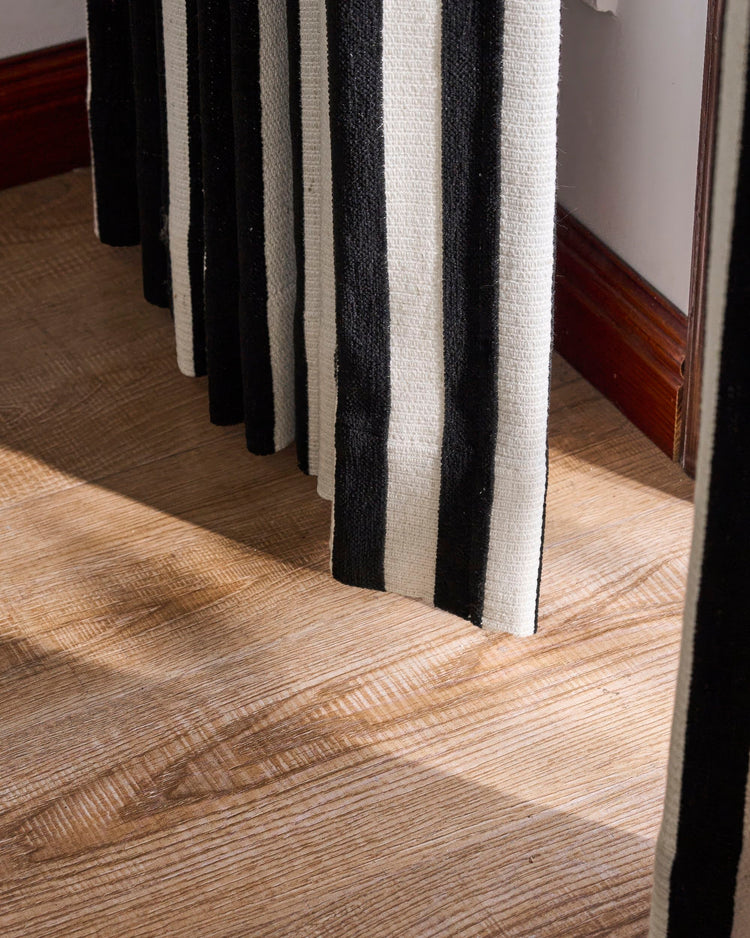
For noise reduction, the bottom edge should not stop too high above the floor. A curtain that just meets the floor usually looks clean and helps reduce the open space below the panel. In rooms where function matters more than a crisp tailored look, a slight break can also help soften the bottom gap.
What noise-reducing curtains can and cannot do
It is important to set realistic expectations. Curtains can help reduce everyday noise and soften how a room sounds, but they do not turn a standard window into a fully soundproof wall.
They usually work better for:
- light traffic noise
- distant voices
- general street sound
- echo inside the room
- wind and higher-pitched outdoor noise
They are less effective against:
- heavy truck vibration
- construction rumble
- bass-heavy music
- thin windows with major air leaks
- noise traveling through walls, ceilings, or doors
If the noise problem is severe, curtains should be one part of a broader plan. Window sealing, rugs, upholstered furniture, door sweeps, and white noise can all help make the room feel more comfortable.
Best rooms for noise-reducing curtains
| Room | Best curtain priority | What to check first |
|---|---|---|
| Bedroom | Blackout lining, fuller coverage, and side-gap control | Top and side light leaks around the window |
| Home office | Dense fabric that softens outside noise without making the room too dark | Whether you still need daylight for work |
| Nursery | Blackout or thermal support with safe, practical hardware | Cord safety, secure mounting, and easy operation |
| Apartment living room | Wide coverage and enough fullness for large windows | Renter-safe mounting rules and wall clearance |
Common mistakes to avoid
If your curtains are not helping as much as expected, check for these common issues before replacing them:
- Choosing fabric that is too light. Decorative panels may look good but usually do not add enough density for noise reduction.
- Measuring only the glass. For better coverage, measure the full area the curtain needs to cover, not just the visible windowpane.
- Leaving side gaps. A standard rod that stops close to the trim can let sound and light leak around the edges.
- Using too little fullness. Flat panels give you less fabric depth and often look less finished.
- Ignoring the window condition. Drafts, loose frames, and poor seals can limit what curtains are able to do.
If you are comparing liner options, review the TheHues curtain liner guide. The liner often makes the difference between a curtain that only looks soft and one that also supports light control, comfort, and noise reduction.
Frequently asked questions
Do noise-reducing curtains really work?
They can help, especially with everyday outside noise and room echo. The best results usually come from heavier fabric, a liner, generous fullness, and an installation that limits gaps around the window.
Are blackout curtains the same as soundproof curtains?
No. Blackout curtains are designed mainly to block light. Some blackout curtains may also help reduce noise because they use denser or layered fabric, but blackout performance and sound reduction are not the same thing.
Should curtains touch the floor for better noise reduction?
In most cases, yes. A curtain that reaches the floor helps reduce the open gap at the bottom. A clean floor-touching length works well for many rooms, while a slight break may add a little more coverage where function matters most.
Can renters use noise-reducing curtains?
Yes, but renters should pay close attention to hardware limits. Dense curtains can be heavy, so make sure any no-drill bracket or tension solution is rated for the weight. If drilling is not allowed, choose the safest setup your lease and window frame can support.
What should I choose if I need both darkness and noise reduction?
Start with blackout curtains that have enough fabric weight and coverage for the window. Then check the liner, fullness, and rod placement. For bedrooms, pairing better fabric with high-and-wide installation usually works better than choosing a basic blackout panel alone.
Final takeaway
Noise-reducing curtains work best when fabric, liner, fullness, and installation all support the same goal. A dense curtain helps, but the setup around it matters just as much.
Start by sealing obvious window gaps, then choose curtains with enough weight, width, and coverage for the room. Use the curtain measurement guide to confirm your size, compare liner options, and reach out to the TheHues free design service if you want help planning a quieter, better-fitted window treatment.