Do Blackout & Thermal Curtains Keep Heat Out (and Cold Out)?


In this article 13 sections
- Do blackout curtains keep heat out?
- Do thermal curtains keep heat out and cold out?
- How do thermal curtains actually work?
- Do thermal curtains work in summer?
- Do thermal curtains keep cold out in winter?
- Blackout vs. thermal vs. insulated vs. lined curtains: what does each actually do?
- The top benefits of thermal insulated curtains
- How do you install curtains so they actually block heat and cold?
- What about drafty doors? Thermal door curtains
- Should you rely on curtains alone for temperature control?
- How do you care for thermal and multi-layer curtains?
- FAQ
- The bottom line
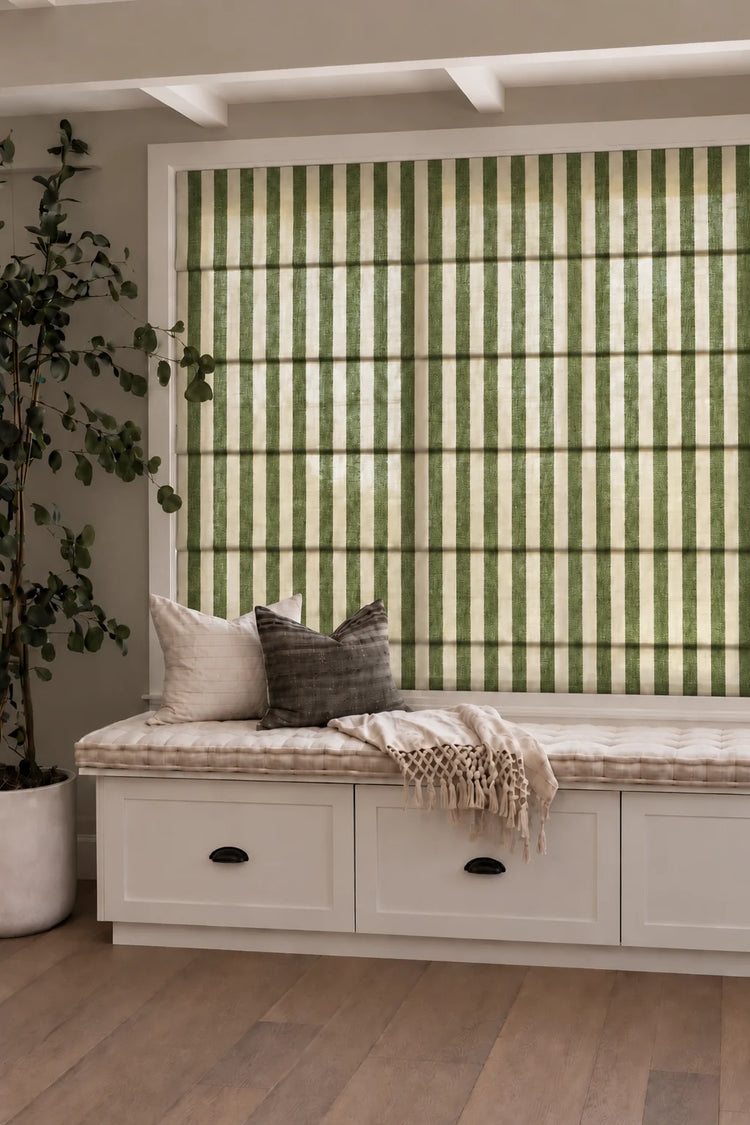
Yes, blackout and thermal curtains can help keep heat out in summer and slow heat loss in winter, but only as a comfort layer over your window, not as a substitute for insulation or new glass. They work by adding a denser barrier in front of the glass that slows heat transfer and traps a pocket of still air. How much you actually feel depends far more on coverage, fit, and mounting than on the fabric label, because even a great thermal fabric leaks at the gaps around the top, sides, center, and floor. This guide explains the physics, separates fabric performance from real-room results, compares blackout vs. thermal vs. insulated vs. lined curtains, and shows how to install them so they actually do their job in both seasons.
Do blackout curtains keep heat out?
Blackout curtains help reduce heat gain, but their main job is blocking light, not regulating temperature. A blackout panel uses a tightly woven or coated fabric, or an added 100% blackout liner, to stop light from passing through the material. That same density also adds body and a still-air layer at the window, which slows some heat transfer as a side benefit.
The important distinction: "100% blackout" describes how much light the fabric blocks, not how dark or cool your room ends up. Light and heat still sneak in around the edges. So if heat control is your goal, you want a blackout panel that is also built or lined for insulation, and you want it installed to seal the perimeter, not just hung flat across the glass.
For light-blocking specifics and how blackout differs from room-darkening, see our guide to what blackout curtains are and how to choose them.

 100% Blackout
 Better sleep
 Noise Reducing
 Energy Saving
Do thermal curtains keep heat out and cold out?
Yes to both, within limits. Thermal curtains do not create heat or cold; they act as a barrier between the window and the room. In summer they slow heat gain from sunlight and warm glass. In winter they slow heat loss and reduce the cold, drafty feeling near the window.
The U.S. Department of Energy notes that properly installed window coverings can help reduce heat loss in winter and heat gain in summer, and that medium-colored draperies with a white backing can help cut solar heat gain during cooling season. That is a directional benefit, not a fixed number for every home. Results vary with your window type, climate, the curtain's construction, and how well it covers the opening. You can read more in the Department of Energy's guide to energy-efficient window attachments.
In plain terms, expect thermal curtains to:
- Reduce the cold feeling near glass at night
- Make a sunny, west-facing room more comfortable in the afternoon
- Soften drafts around older, leakier windows
- Add privacy, light control, and a finished look
Do not expect them to fix poor wall insulation, reseal a failed window, or replace double-pane glass.

How do thermal curtains actually work?
Three simple mechanisms do the work:
- They slow heat transfer. Windows lose and gain heat faster than walls. A denser panel in front of the glass slows the movement of heat between the room and the colder or hotter window surface.
- They trap a still-air pocket. When a panel hangs close to the window and overlaps the frame, it holds a layer of still air between fabric and glass. Still air is a poor conductor, so that pocket does much of the insulating. This is why a curtain held tight to the wall outperforms the same fabric hung loose with gaps.
- They reduce air movement around the window. A curtain cannot reseal a leaky frame, but covering the opening more completely limits how freely air circulates past the cold or hot glass.
Because the still-air pocket matters so much, how you hang the curtain often matters as much as the fabric you buy. A premium thermal panel that leaves open gaps at the top and sides behaves a lot like an ordinary decorative drape.
Do thermal curtains work in summer?
Yes, when used correctly. In summer the goal is to stop solar heat before it builds up inside, so timing and the window-facing side of the fabric matter most.
- The backing is the workhorse. A white or light, reflective window-facing backing bounces more sunlight back toward the glass; a dark backing tends to absorb more heat. The decorative, room-facing side can still be any color or texture you like. The side facing the street is what drives summer performance. If you love a dark or natural look, that is exactly what a do-linen-curtains-block-heat-what-you-need-to-know.
- Time it to the sun. Close panels on east-facing windows in the morning and on west-facing windows through the hot afternoon. South-facing windows collect heat steadily, so they benefit from being covered during peak sun.
- Treat curtains as a supporting player. They reduce the rate of heat entry; they do not generate cool air. Pair them with shading, sealing, and an efficient cooling system for the best result. Think sunglasses, not air conditioner.
For a current shortlist of fabrics and configurations built for hot rooms, see our curtains to keep heat out picks.
Do thermal curtains keep cold out in winter?
Yes. In winter, thermal curtains slow heat loss at the glass and cut the drafty feeling near the window, especially helpful for older or single-pane windows, bedrooms that feel cold at night, large glass areas, and apartments where you cannot replace the windows.
Use them strategically instead of leaving them in one position all day:
- Open them during sunny periods to let free solar warmth into the room.
- Close them after sunset and overnight to hold heat in.
- Make sure panels overlap the frame and the center closes, so the still-air pocket actually forms.
For fabric choice in cold climates, density is what insulates. Velvet brings a heavy, dense pile that hangs straight and seals well against drafts. A linen or cotton look is fine for style, but unlined natural fabric is too porous to insulate on its own. Choose a version with a thermal or blackout liner so the backing does the work. If you want help matching fabric to a cold room, start with our thermal curtains buyer's guide.
Blackout vs. thermal vs. insulated vs. lined curtains: what does each actually do?
These terms overlap and are often used loosely. Here is what each one primarily does for heat and cold, so you can match the label to your goal.
| Type | What it primarily does | Heat/cold effect | Best for |
|---|---|---|---|
| Blackout | Blocks light through the fabric with a tight weave, coating, or 100% blackout liner | Adds density and a still-air layer, so it helps with temperature as a side benefit | Sleep, glare control, nurseries, media rooms |
| Thermal | Slows heat transfer at the window | Direct temperature focus; reduces heat gain in summer and heat loss in winter | Sunny or drafty rooms, older windows, year-round comfort |
| Insulated | Often used interchangeably with thermal; emphasizes a denser or multi-layer build | Similar to thermal; the insulating layer is the point | Cold climates, large glass, comfort-first rooms |
| Lined | A separate functional liner behind a decorative face fabric | Depends on the liner: a thermal or blackout liner adds insulation and light blocking | Keeping a favorite face fabric while adding performance |
The practical takeaway: a single panel can be more than one of these at once. Many TheHues panels combine blackout, thermal, and sound-reducing properties in one construction. If the terminology trips you up, we break it down further in thermal vs. insulated curtains and lined vs. thermal curtains.

Where four-layer curtains fit in
TheHues four-layer soundproof/thermal curtains are a distinct construction, not an ordinary panel with a generic liner. They combine a decorative face fabric, a high-density sound-absorbing felt layer, an additional nonwoven air-purifying layer, and a backing or liner. That dense build improves light blocking, adds thermal resistance, and can reduce perceived street noise and room echo in one panel.
A note on acoustics: dense curtains are noise-reducing and sound-absorbing, not soundproof. TheHues four-layer product copy states noise reduction can reach up to about 15 dB under ideal conditions, while also noting that real results vary with gaps, room construction, and noise frequency. Treat that as a best-case product figure, not a guaranteed in-home result.


The top benefits of thermal insulated curtains
Beyond heat and cold, a well-built thermal panel earns its place several ways:
- Year-round temperature comfort. One panel can help in both summer and winter when the backing and fit are right.
- Light control and better sleep. Density that insulates also helps darken a room, useful for bedrooms, nurseries, and shift workers.
- Privacy. A heavier, opaque panel blocks sightlines from outside, especially after dark when interior lights are on.
- Noise reduction. Dense, well-covering panels soften street sound and indoor echo. They are noise-reducing, not soundproof.
- Furniture and floor protection. Reducing direct sun helps limit fading of furnishings near sun-exposed windows.
- A finished, custom look. Floor-length, properly proportioned drapery makes a window feel intentional and the room feel complete.
The common thread: most of these benefits depend on coverage and fit, not just the fabric name on the tag.
How do you install curtains so they actually block heat and cold?
This is where most curtains underperform. Even excellent thermal fabric leaks heat and light at the perimeter, so coverage, overlap, and mounting decide the real-room result.
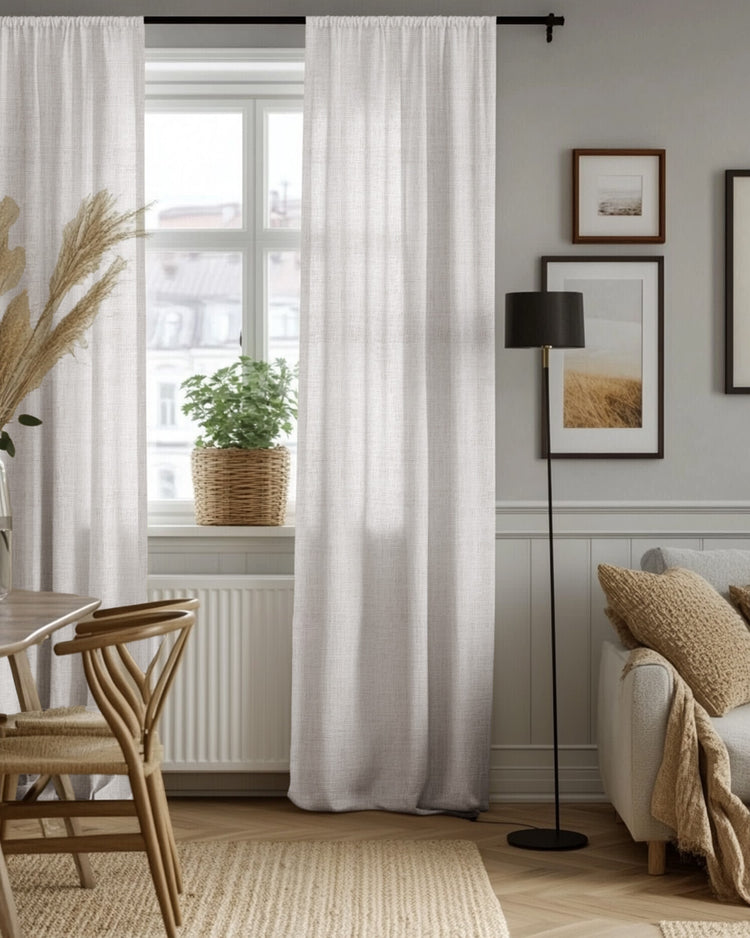
- Mount high. TheHues typically recommends placing the rod about 4 to 8 inches above the window frame. This lifts the top of the still-air pocket above the glass and reduces the top gap.
- Extend beyond the sides. When wall space allows, extend the rod beyond the frame on each side so the panels overlap the wall, not just the glass. TheHues recommends extending roughly 4 to 12 inches beyond each side depending on wall space, stack-back, and how much you want to block light and drafts.
- Favor more overlap for performance. For heat and light control, prioritize side overlap and a center closure that overlaps, plus hardware that brings the panel back toward the wall. Fabric alone does not seal the perimeter.
- Close the center. With two panels, make sure they overlap in the middle so there is no center light-and-air gap.
- Mind the floor finish. A length that reaches the floor reduces the bottom gap. TheHues offers a hover finish, about 1 inch above the floor, for active, pet-friendly, or uneven-floor rooms, and a puddle finish, about 3 inches onto the floor, for a softer, more formal look that gathers more dust.
A note on fullness for heavy thermal panels
Do not assume the old "2 to 2.5 times the window width" rule. TheHues fullness is header- and construction-specific, and heavy four-layer panels use lower ratios with soft headers because too much dense fabric becomes heavy and hard to draw. As a guide, four-layer soundproof panels use about 1.5x on grommet tops and roughly 1.2x on rod-pocket or back-tab headers, while pleated headers already have fullness sewn in, so order about 1.1x the rod width. Match your hardware to the real finished weight. Heavy panels need rods or tracks rated for the load, not light-duty clip rings. When in doubt, use the TheHues measurement guide and confirm the ratio on your selected product page.
What about drafty doors? Thermal door curtains
Doors are a frequently overlooked source of drafts and heat swings. Entryways, patio and sliding glass doors, mudrooms, and back doors all let air move between inside and outside. A heavy thermal panel over a drafty door works the same way it does over a window: it traps a still-air layer and slows heat transfer, stabilizing the temperature near the opening.
The same install rules apply, and fit is even more critical here: mount high and wide so the panel overlaps the frame on all sides, and choose a length that reduces the bottom gap without blocking door operation. For sliding glass doors, use a track or rod that lets the panel slide fully open when you want the light and view. Measure the installed rod or track and the door's travel, not just the glass, and check handle and threshold clearance before ordering.
Should you rely on curtains alone for temperature control?
No. Curtains are a smart, low-effort, renter-friendly comfort layer, but they are one part of a strategy. They cannot fix poor wall or attic insulation, reseal a failed window, or replace single-pane glass. If every room runs hot or cold, the issue is more likely HVAC, insulation, or air sealing.
For stronger results, layer treatments. Cellular, or honeycomb, shades trap air right at the glass and insulate efficiently in a compact footprint; thermal curtains add coverage over the perimeter plus softness, privacy, and style. Using both, shade close to the glass and curtain over it, gives two layers of protection and a finished look.
Watch out for heaters below the window
Before choosing floor-length panels, check what sits under the window. If there is a radiator, heating vent, or electric baseboard heater below it, a long curtain can trap warm air behind the fabric and push it toward the cold glass instead of into the room, and fabric near an electric baseboard heater is a safety concern. In those rooms, use sill- or apron-length panels that stop above the heat source, add a vent deflector, or pair blinds with a valance. Always follow the heater manufacturer's clearance guidelines.
How do you care for thermal and multi-layer curtains?
Care is product-specific, so do not assume every thermal curtain is machine washable. Some linen-look and linen-blend panels allow a cold, gentle machine wash with line drying; coated, velvet, lined, and multi-layer panels often do not. Some multi-layer products require removing detachable felt or liner components before any cleaning.
Always follow the individual product care label. As a safe default, dust regularly, spot-test cleaning in an inconspicuous area, and contact TheHues support before fully washing a panel when no clear instruction is available. Never tumble dry, bleach, scrub a coating, or use high heat unless the specific product explicitly allows it.
FAQ
Do blackout curtains keep heat out?
Yes, partially. Blackout curtains are built mainly to block light, but their dense fabric also adds a still-air layer that slows some heat transfer. For real summer heat control, choose a blackout panel that is also thermal or lined, and install it to cover the perimeter, not just the glass.
Do thermal curtains actually work?
Yes, when closed and installed well. They reduce drafts, slow heat transfer, and block strong sun, most noticeably on older, drafty, or sun-exposed windows. They are a comfort upgrade, not a replacement for insulation or new windows.
Do thermal curtains keep cold out?
Yes. They slow heat loss at the glass and reduce the cold, drafty feeling near windows in winter. The effect is strongest on single-pane or older windows and depends on closing the panels and minimizing gaps.
Do thermal curtains work in summer?
Yes, especially with a white or reflective window-facing backing and when closed during strong afternoon sun. They are most helpful on south- and west-facing windows.
Do curtains keep heat in during winter?
Yes. A denser, well-fitted panel slows heat from escaping toward the cold glass. Mount high and wide, overlap the frame and the center, and close panels after sunset for the best effect.
Are blackout curtains the same as thermal curtains?
Not always. Blackout focuses on blocking light; thermal focuses on temperature. Many panels do both, but check the fabric, lining, and backing to confirm.
What color thermal curtains work best?
For summer, the window-facing backing matters most. White or reflective backing reflects more sun. The room-facing side can be any color. For winter, fabric density and fit matter more than front color.
Should thermal curtains touch the floor?
A floor-length panel reduces the bottom gap and improves coverage, but never let it rest on or near a radiator or electric baseboard heater. If a heat source sits below the window, choose a safer shorter length.
Do thermal curtains work if they are left open?
Not for temperature. They need to cover the window to trap the still-air pocket and slow heat transfer. Open, they are mostly decorative.
The bottom line
Blackout and thermal curtains do keep heat out and cold out, but as a comfort layer, not a miracle. The fabric sets the ceiling on performance; coverage and fit decide what you actually feel. Choose density and the right backing for your season, then install high, wide, and close to the wall with the center overlapping so the still-air pocket can form. For a cold bedroom, a sunny west-facing room, an apartment, or an older home, a well-chosen, well-hung thermal or blackout panel is a practical, stylish upgrade. If you want help matching fabric, lining, and fit to your room, start with the thermal curtains buyer's guide or use the TheHues free design service.